January 30, 2026

AI demo agents vs AI chatbots: Where they fit in your 2026 GTM funnel

Read More

January 30, 2026

AI demo agents vs AI chatbots: Where they fit in your 2026 GTM funnel

Read More

If your GTM meeting starts with "How many MQLs did we generate?", you're measuring the wrong thing.

For years, B2B teams followed a simple playbook: capture an email, score it as an MQL, hand it to sales. Repeat. The flaw was obvious in hindsight — most “qualified” leads were not buyers. They were researchers looking for information.

Then came AI chatbots.

They were meant to fix the problem, and to an extent, they did. Visitors could ask questions, get instant responses, and experience something closer to a conversation. Yet most prospects still left unsatisfied.

The issue is not that chatbots fail. They handle predictable questions really well — pricing, integrations, product basics. Buyers bounce for a different reason: they do not get their answer. The one tied to their use case, constraints, and context.

Chatbots don’t fail because they can’t answer questions—they fail because they can’t answer them in context.

What has changed is buyer behavior. People now have daily, high-quality conversations with generative AI tools like ChatGPT. They ask complex questions and receive tailored, contextual responses immediately. When they arrive on your website, they expect the same. They want to see how your product solves their problem — without forms, delays, or waiting for a demo.

Sales teams also feel this gap downstream. A transcript shows someone asked about integrations, but not whether they are casually browsing or deep into an evaluation. The signal is missing.

This is where autonomous AI—specifically AI demo agents—enters the picture. In this article, we break down how AI demo agents differ from traditional chatbots, and where each fits within a modern GTM strategy.

How AI chatbots work — and where they stop

How AI chatbots work — and where they stop

AI chatbots exist to answer questions. They are text-based interfaces on a website that interpret what a visitor types, match it to known content or intents, and return a response. In practice, they operate in a simple loop: read the question, pull a relevant answer from predefined content such as a knowledge base, respond, and wait for the next input.

This means they are built with a clear endpoint. Their job is to answer the question, route the conversation, book a demo, or hand off to a human. They are not designed to stay with a buyer through exploration or decision-making. 

That’s why they struggle with complex or ongoing conversations. When questions depend on context or require back-and-forth, chatbots often fall short.

AI chatbots exist to answer questions. They are text-based interfaces on a website that interpret what a visitor types, match it to known content or intents, and return a response. In practice, they operate in a simple loop: read the question, pull a relevant answer from predefined content such as a knowledge base, respond, and wait for the next input.

This means they are built with a clear endpoint. Their job is to answer the question, route the conversation, book a demo, or hand off to a human. They are not designed to stay with a buyer through exploration or decision-making. 

That’s why they struggle with complex or ongoing conversations. When questions depend on context or require back-and-forth, chatbots often fall short.

In a 2024 survey by Verint, 68% of respondents reported having a bad chatbot experience, most often because the chatbot could not answer their question or failed to understand what they actually needed. Another 36% said it took too long for the chatbot to realize it couldn’t help, which only made the experience more frustrating.

Put simply, chatbots — even the AI ones — are optimized for speed over depth and safety over specificity. That design makes chatbots effective at handling a high volume of simple interactions. This includes:

  • Answering predictable questions (pricing, features, integrations)

  • Handling basic support requests

  • Routing conversations to the right team

  • Scheduling demos or meetings

As these conversations happen, chatbots log what is said. You can see the questions asked, the topics covered, and the full transcript. The data reflects the dialogue itself, not the buyer’s intent or situation.

Because of that, chatbots fit at the top of the GTM funnel and in support workflows. That is why they most often show up inside help desk and customer support platforms like Intercom and Nextiva. These systems are built to handle high volumes of inbound questions, route requests efficiently, and resolve issues quickly — exactly the environment where chatbots perform best.

What they are not built for is buyer engagement. Chatbots can explain what your product does, but they cannot help a buyer assess whether it fits their workflow, compare it meaningfully against alternatives, or see how it would work in their specific scenario.

Put simply, chatbots — even the AI ones — are optimized for speed over depth and safety over specificity. That design makes chatbots effective at handling a high volume of simple interactions. This includes:

  • Answering predictable questions (pricing, features, integrations)

  • Handling basic support requests

  • Routing conversations to the right team

  • Scheduling demos or meetings

As these conversations happen, chatbots log what is said. You can see the questions asked, the topics covered, and the full transcript. The data reflects the dialogue itself, not the buyer’s intent or situation.

Because of that, chatbots fit at the top of the GTM funnel and in support workflows. That is why they most often show up inside help desk and customer support platforms like Intercom and Nextiva. These systems are built to handle high volumes of inbound questions, route requests efficiently, and resolve issues quickly — exactly the environment where chatbots perform best.

What they are not built for is buyer engagement. Chatbots can explain what your product does, but they cannot help a buyer assess whether it fits their workflow, compare it meaningfully against alternatives, or see how it would work in their specific scenario.

How AI demo agents pick up where chatbots leave off

How AI demo agents pick up where chatbots leave off

AI demo agents exist to move discovery earlier in the buyer journey. They are autonomous agents that sit on your website, show the product based on what the buyer is actually asking about, and pass along context before sales ever gets involved.

In a typical inbound sales flow, discovery starts days after someone visits your site. A form gets filled, a call gets scheduled, and the first part of that call is spent asking basic questions the buyer has already worked through on their own. By the time real discussion starts, momentum is already slipping.

AI demo agents change that by starting discovery on the website itself. When a buyer lands on a high-intent page, the agent engages immediately and helps them explore the product directly. It can launch a guided demo of a feature, adjust the demo flow to match the buyer’s role or industry, or answer questions by pointing to the exact place in the product where that use case is handled.

As the buyer interacts, the experience adapts based on what they ask and what they click into:

  • A technical buyer asking about integrations might be shown an API flow, an example setup, or an implementation walkthrough. 

  • A business buyer focused on pricing might be walked through plan differences or cost drivers.

This is what “discovery through use” looks like in practice. Instead of stepping through a qualification checklist, the buyer spends time inside the product or demo itself. Their behavior becomes the signal.

Someone who skims a few screens and leaves is doing something very different from someone who spends several minutes reviewing security settings, asks about SOC 2 timelines, and compares integration options. That difference shows up clearly during a single session.

AI demo agents exist to move discovery earlier in the buyer journey. They are autonomous agents that sit on your website, show the product based on what the buyer is actually asking about, and pass along context before sales ever gets involved.

In a typical inbound sales flow, discovery starts days after someone visits your site. A form gets filled, a call gets scheduled, and the first part of that call is spent asking basic questions the buyer has already worked through on their own. By the time real discussion starts, momentum is already slipping.

AI demo agents change that by starting discovery on the website itself. When a buyer lands on a high-intent page, the agent engages immediately and helps them explore the product directly. It can launch a guided demo of a feature, adjust the demo flow to match the buyer’s role or industry, or answer questions by pointing to the exact place in the product where that use case is handled.

As the buyer interacts, the experience adapts based on what they ask and what they click into:

  • A technical buyer asking about integrations might be shown an API flow, an example setup, or an implementation walkthrough. 

  • A business buyer focused on pricing might be walked through plan differences or cost drivers.

This is what “discovery through use” looks like in practice. Instead of stepping through a qualification checklist, the buyer spends time inside the product or demo itself. Their behavior becomes the signal.

Someone who skims a few screens and leaves is doing something very different from someone who spends several minutes reviewing security settings, asks about SOC 2 timelines, and compares integration options. That difference shows up clearly during a single session.

We tested this with Path AI — Layerpath's own AI demo agent — on our website. Within 9 days, we saw 100+ website conversations, 10+ meetings booked, and 2 paying customers without spending a dollar on ads. The traffic didn't change. What changed was what happened when people landed
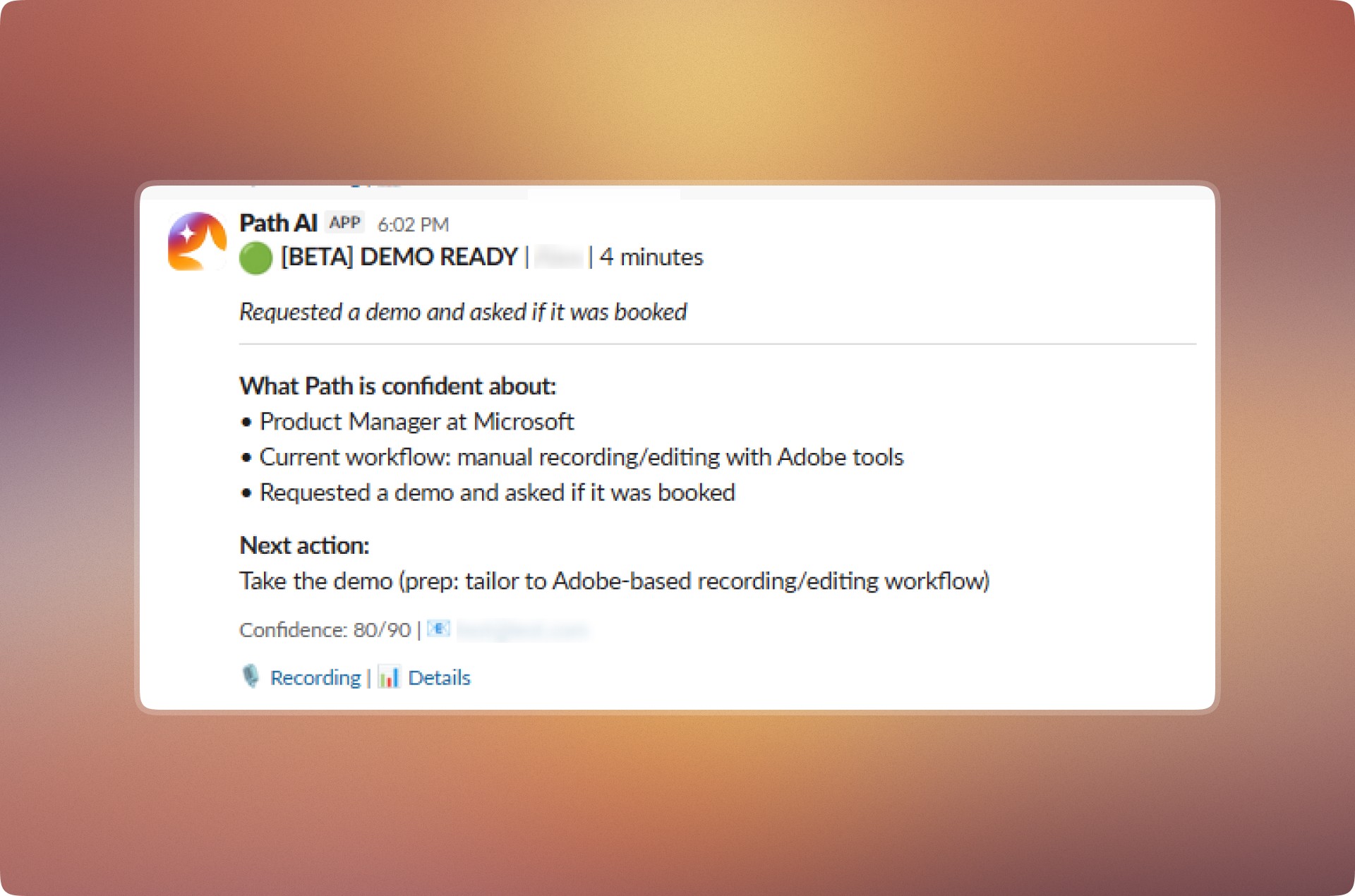
Path AI summarizing buyer intent on Slack
By the time sales gets involved, that context is already there. Reps know what the buyer has seen, what questions were raised, and where uncertainty remains. 

That’s why AI demo agents AI demo agents sit between acquisition and sales in the inbound GTM motion.

They engage after someone lands on your site but before they're handed to an SDR or AE. The goal is website conversions — while the buyer is still exploring on their own terms.

By the time sales gets involved, discovery has already happened. The buyer has explored relevant features, asked their questions, and signaled what matters. Sales isn't qualifying from zero — they're continuing a conversation that's already moving.

By the time sales gets involved, that context is already there. Reps know what the buyer has seen, what questions were raised, and where uncertainty remains. 

That’s why AI demo agents AI demo agents sit between acquisition and sales in the inbound GTM motion.

They engage after someone lands on your site but before they're handed to an SDR or AE. The goal is website conversions — while the buyer is still exploring on their own terms.

By the time sales gets involved, discovery has already happened. The buyer has explored relevant features, asked their questions, and signaled what matters. Sales isn't qualifying from zero — they're continuing a conversation that's already moving.

The architecture: How AI demo agents are structurally differently than chatbots

The architecture: How AI demo agents are structurally differently than chatbots

Most chatbots are optimized around conversational response — parsing input, retrieving an answer, and replying. The architecture is built to handle questions, not to guide someone through a product.

AI demo agents work differently. They combine conversational intelligence with interactive product experiences. Instead of answering a question about a feature, they show it. As the buyer interacts, the agent tracks what features they click into, how long they spend in each section, what objections surface, and uses that behavior to decide what to show next.

That's the fundamental shift: chatbots respond within a conversation. Demo agents also control the entire experience. They decide which feature to surface based on the buyer's questions and behavior, adjust the demo flow without predefined logic, and determine when a prospect is ready for sales based on realtime engagement signals — not form fills or scoring rules.

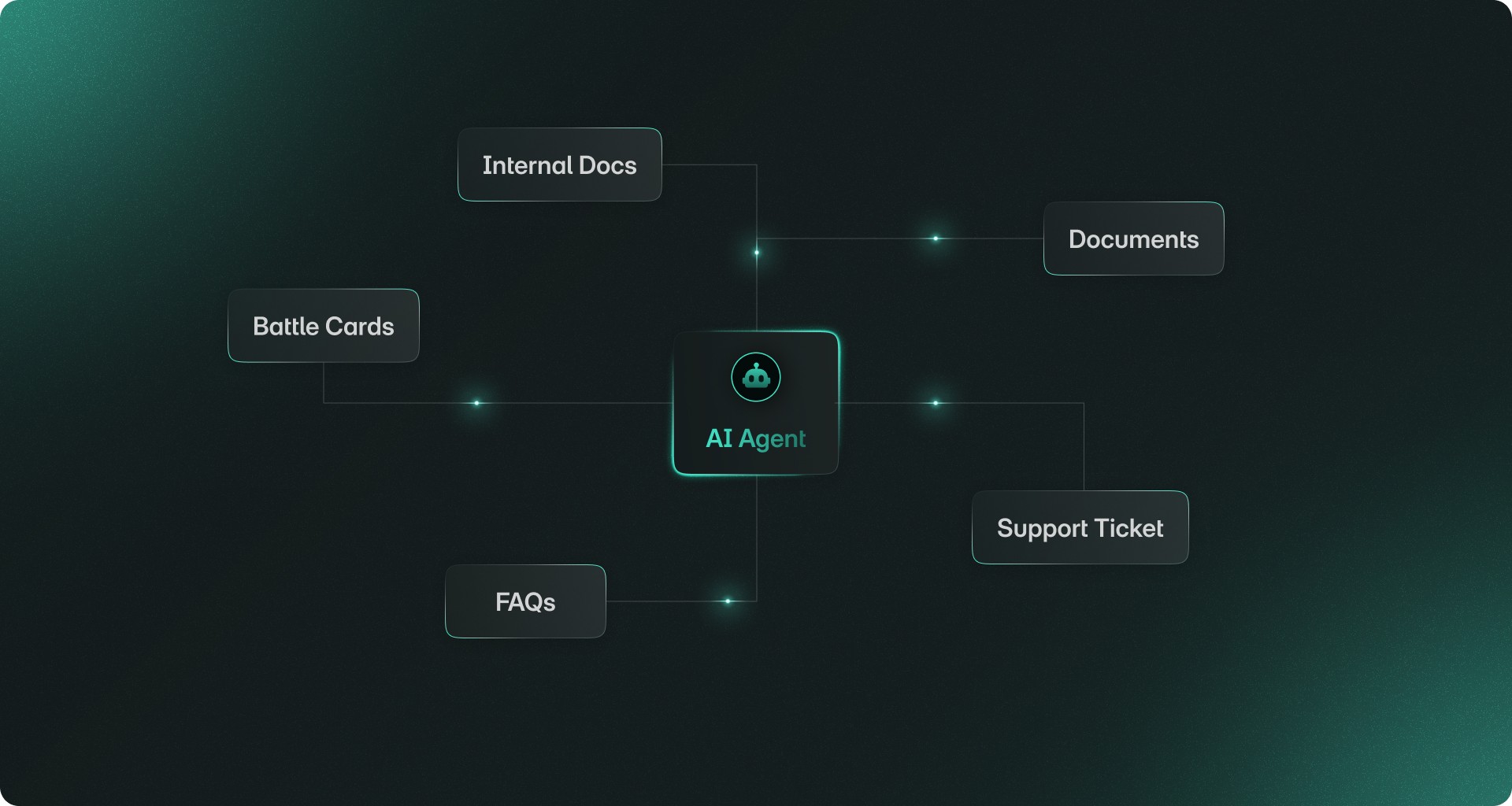
What makes this possible is what they're trained on:

  • Chatbots pull from a knowledge base — internal documentation, FAQs, help articles. 

  • Demo agents can be trained on your actual demos, sales recordings, product videos, internal enablement materials, and even sales frameworks like MEDDIC or BANT.

Most chatbots are optimized around conversational response — parsing input, retrieving an answer, and replying. The architecture is built to handle questions, not to guide someone through a product.

AI demo agents work differently. They combine conversational intelligence with interactive product experiences. Instead of answering a question about a feature, they show it. As the buyer interacts, the agent tracks what features they click into, how long they spend in each section, what objections surface, and uses that behavior to decide what to show next.

That's the fundamental shift: chatbots respond within a conversation. Demo agents also control the entire experience. They decide which feature to surface based on the buyer's questions and behavior, adjust the demo flow without predefined logic, and determine when a prospect is ready for sales based on realtime engagement signals — not form fills or scoring rules.

What makes this possible is what they're trained on:

  • Chatbots pull from a knowledge base — internal documentation, FAQs, help articles. 

  • Demo agents can be trained on your actual demos, sales recordings, product videos, internal enablement materials, and even sales frameworks like MEDDIC or BANT.

What Path AI is trained on.

The result isn't just accurate information, it's how your team would deliver that information in a live conversation.

And when sales gets involved, they don't receive a chat transcript. They get a record of what the buyer explored, where they spent time, and what questions came up. Context before the first call.

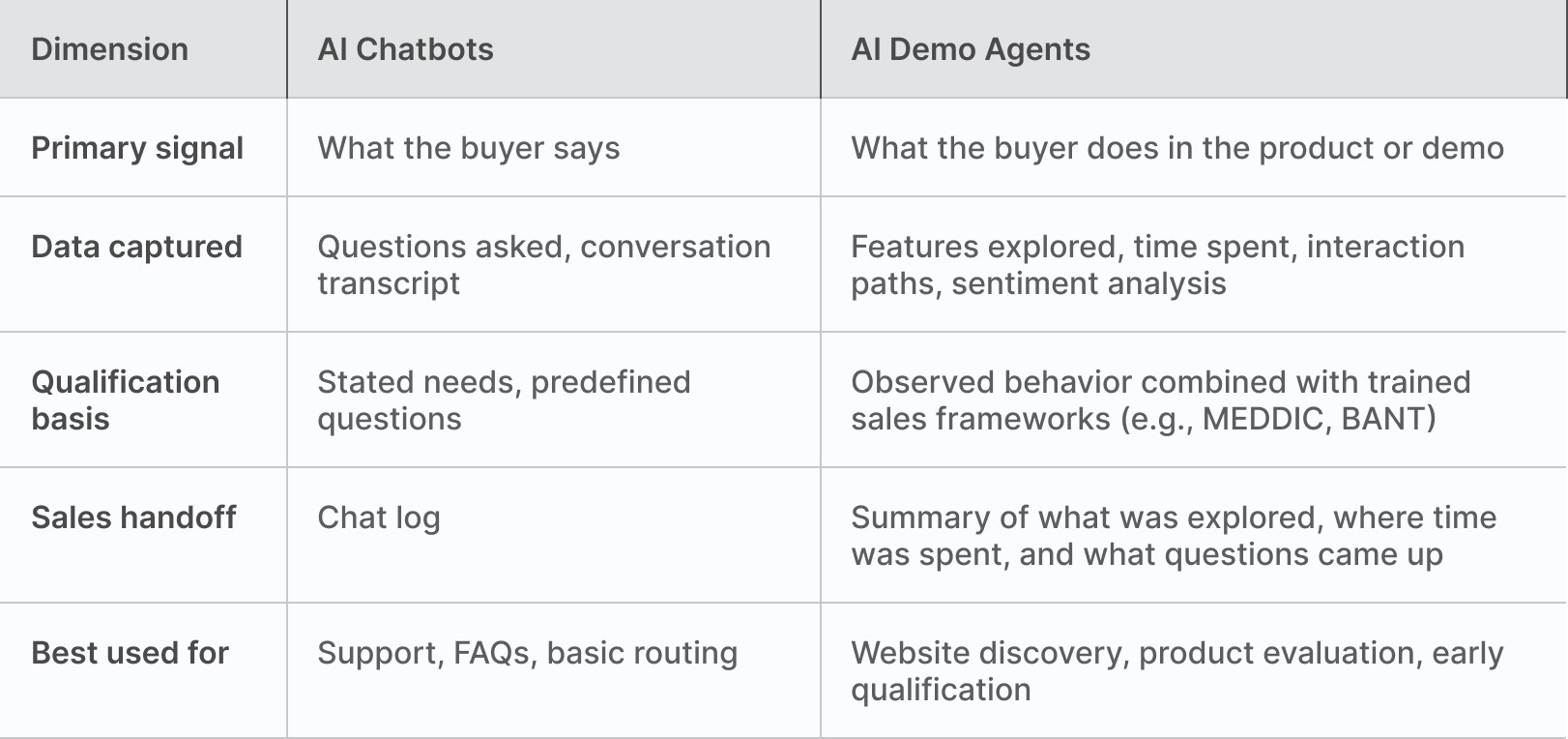
Dimension

AI Chatbots

AI Demo Agents

Primary signal

What the buyer says

What the buyer does in the product or demo

Data captured

Questions asked, conversation transcript

Features explored, time spent, interaction paths, sentiment analysis

Qualification basis

Stated needs, predefined questions

Observed behavior combined with trained sales frameworks (e.g., MEDDIC, BANT)

Sales handoff

Chat log

Summary of what was explored, where time was spent, and what questions came up

Best used for

Support, FAQs, basic routing

Website discovery, product evaluation, early qualification

Here's what that looks like with three different buyers evaluating the same product:

  • A startup asks: "How much does this cost? Can I try it? How long does setup take?"

  • A mid-market company asks: "What integrations do you support? Can we customize workflows? What does onboarding look like?"

  • An enterprise buyer asks: "What's your SOC 2 status? Do you offer white-label? Who owns the data?"

A chatbot can answer all three. It'll explain pricing, list your integrations, link to your SOC 2 report. But the experience is the same for everyone—text responses pulled from documentation.

A demo agent, on the other hand, launches an interactive experience:

  • The startup gets a guided walkthrough of the product and sees exactly what setup involves. 

  • The mid-market buyer is shown how integrations work with a live example they can click through. 

  • The enterprise contact is walked through security settings, compliance documentation, and data ownership controls. 

Same product, three completely different experiences based on what each buyer needs to evaluate.

Conversation data vs product-intent intelligence

Conversation data vs product-intent intelligence

Chatbots are conversation-first. They track dialogue: what questions were asked, how the conversation progressed, what topics came up. The signal comes from what people say. If someone asks about integrations, then pricing, then onboarding timelines, the chatbot logs that sequence. Sales gets a transcript that shows interest, but not depth.

Chatbots are conversation-first. They track dialogue: what questions were asked, how the conversation progressed, what topics came up. The signal comes from what people say. If someone asks about integrations, then pricing, then onboarding timelines, the chatbot logs that sequence. Sales gets a transcript that shows interest, but not depth.

You know they asked about integrations, but you don't know if they care deeply or were just checking a box.

Demo agents are behavior-first. They track product interaction — what features were explored, how long someone spent in each section, where they clicked, what they skipped. The signal comes from what people do.

Demo agents are behavior-first. They track product interaction — what features were explored, how long someone spent in each section, where they clicked, what they skipped. The signal comes from what people do.

If someone spends eight minutes exploring your API documentation, tests a sample integration flow, and then asks about rate limits, that's not casual browsing.

The gap is that chat tools can't see product behavior. They live in text. Demo agents live in the product experience itself. And demo behavior—clicks, time spent, features explored—is a stronger predictor of purchase readiness than questions asked. 

Someone who asks "Do you have SSO?" might be doing early research. Someone who explores your SSO configuration screen, reviews your SAML setup guide, and asks about custom attribute mapping is actively evaluating whether your implementation will work for their environment. 

The difference between those two is everything, and only one of them shows up in a chat transcript.

The gap is that chat tools can't see product behavior. They live in text. Demo agents live in the product experience itself. And demo behavior—clicks, time spent, features explored—is a stronger predictor of purchase readiness than questions asked. 

Someone who asks "Do you have SSO?" might be doing early research. Someone who explores your SSO configuration screen, reviews your SAML setup guide, and asks about custom attribute mapping is actively evaluating whether your implementation will work for their environment. 

The difference between those two is everything, and only one of them shows up in a chat transcript.

The language-intent gap and AI demo agents

Buyers now arrive with specific, situational questions. Something like, “We’re a 200-person SaaS company with a PLG motion. Can your product handle usage-based pricing across three regions?”

There is no FAQ for that. To respond meaningfully, you have to reason through the setup and show how the product behaves in that scenario.

Chatbots can talk through an answer by pulling from documentation, but the interaction breaks apart quickly. They answer a question, drop a link, and wait for the next prompt. What’s said in the conversation has no direct connection to what the buyer does next. The buyer clicks away, reads pages on their own, and decides — separately — whether any of it applies to their situation.

Demo agents don’t split those steps. They explain and show at the same time. Instead of describing support for usage-based pricing, they show how it’s configured and how multi-region behavior works, inside the same flow. The conversation and the product exploration stay connected.

With Path AI, this happens in real time. The agent carries on the conversation while opening the relevant demo as questions come up. A buyer asks something specific, the agent shows the exact part of the product that answers it, and then adjusts as the buyer clicks or asks follow-ups. The continuity isn’t just in what’s said — it’s in what the buyer can actually do next.

The future of inbound is autonomous buyer enablement

The future of inbound is autonomous buyer enablement

According to Gartner, AI agents will outnumber human sellers 10x by 2028. But only 40% of sales leaders believe it would be productive. According to Melissa Hilbert, VP Analyst in the Gartner Sales Practice:

“AI agents are everywhere, but there’s a value ceiling. Beyond a certain point, more AI does not mean more productivity. In fact, layering additional prompts and tools onto already complex workflows risks overwhelming sellers and accelerating burnout.”

The issue isn't AI. It's where it's deployed. Adding AI to help sellers manage more conversations doesn't solve the root problem — it just speeds up a broken process. Path AI is built differently. It's designed to enable buyers independently, before sales gets involved. 

Here’s how Path AI turns your website into an autonomous buyer enablement engine:

  • It shows your product in real time: Path AI doesn't send buyers to help docs or schedule calls—it opens the actual product and demonstrates the answer. The product becomes the response, delivered in context while the buyer is still engaged. There's no gap between question and demo.

  • It qualifies through observed behavior: Path AI tracks which features buyers explore, how long they engage with each section, and what objections surface as they interact. By the time sales connects, they already know what the prospect cared about, where they spent time, and where friction appeared. 

The result is a fundamentally different inbound motion. Buyers get immediate access to the product experience they expect. And sales get leads who are actually ready to talk.

Curious to learn more? Sign up for early access, and see firsthand how AI voice demo agents can drive real revenue impact. And if you’d like to geek out about the potential of agentic AI and conversational AI demos, you can schedule a 30-minute call with Vinay, our founder.

Frequently asked questions (FAQs)

Frequently asked questions (FAQs)

1. What is the difference between an AI chatbot and an AI demo agent?

Chatbots answer questions by pulling from your knowledge base. Demo agents show your product. When someone asks how a feature works, a chatbot explains it. A demo agent, on the other hand, opens that part of your product demo and lets them explore it. The difference is text versus experience.

2. What ROI can I expect from AI demo agents vs chatbots?

Chatbots reduce support load and speed up response times. Demo agents increase conversion by moving discovery earlier because buyers who interact with your product convert at higher rates than those who just read about it. 

3. Do I need both an AI chatbot and a demo agent on my website?

3. Do I need both an AI chatbot and a demo agent on my website?

It depends on where your bottleneck is. If you're drowning in support tickets or basic FAQs, a chatbot helps. If your problem is low conversion from traffic to pipeline, or sales wasting time on unqualified leads, a demo agent addresses that. Many companies use both — a chatbot for support, a demo agent for inbound discovery.

  1. What signals do AI demo agents track that chatbots miss?

Chatbots track what people say. Demo agents track what people do such as which features they explore, how long they spend in each section, what they click on, where they hesitate. A prospect who spends 10 minutes testing your API and asks about rate limits is signaling different intent than one who asks "Do you have an API?" Behavior reveals buying stage more accurately than conversation.
If your GTM meeting starts with "How many MQLs did we generate?", you're measuring the wrong thing.

For years, B2B teams followed a simple playbook: capture an email, score it as an MQL, hand it to sales. Repeat. The flaw was obvious in hindsight — most “qualified” leads were not buyers. They were researchers looking for information.

Then came AI chatbots.

They were meant to fix the problem, and to an extent, they did. Visitors could ask questions, get instant responses, and experience something closer to a conversation. Yet most prospects still left unsatisfied.

The issue is not that chatbots fail. They handle predictable questions really well — pricing, integrations, product basics. Buyers bounce for a different reason: they do not get their answer. The one tied to their use case, constraints, and context.

What has changed is buyer behavior. People now have daily, high-quality conversations with generative AI tools like ChatGPT. They ask complex questions and receive tailored, contextual responses immediately. When they arrive on your website, they expect the same. They want to see how your product solves their problem — without forms, delays, or waiting for a demo.

Sales teams also feel this gap downstream. A transcript shows someone asked about integrations, but not whether they are casually browsing or deep into an evaluation. The signal is missing.

This is where autonomous AI—specifically AI demo agents—enters the picture. In this article, we break down how AI demo agents differ from traditional chatbots, and where each fits within a modern GTM strategy.

Chatbots don’t fail because they can’t answer questions—they fail because they can’t answer them in context.

How AI chatbots work — and where they stop

AI chatbots exist to answer questions. They are text-based interfaces on a website that interpret what a visitor types, match it to known content or intents, and return a response. In practice, they operate in a simple loop: read the question, pull a relevant answer from predefined content such as a knowledge base, respond, and wait for the next input.

This means they are built with a clear endpoint. Their job is to answer the question, route the conversation, book a demo, or hand off to a human. They are not designed to stay with a buyer through exploration or decision-making. 

That’s why they struggle with complex or ongoing conversations. When questions depend on context or require back-and-forth, chatbots often fall short.

Put simply, chatbots — even the AI ones — are optimized for speed over depth and safety over specificity. That design makes chatbots effective at handling a high volume of simple interactions. This includes:

  • Answering predictable questions (pricing, features, integrations)

  • Handling basic support requests

  • Routing conversations to the right team

  • Scheduling demos or meetings

As these conversations happen, chatbots log what is said. You can see the questions asked, the topics covered, and the full transcript. The data reflects the dialogue itself, not the buyer’s intent or situation.

Because of that, chatbots fit at the top of the GTM funnel and in support workflows. That is why they most often show up inside help desk and customer support platforms like Intercom and Nextiva. These systems are built to handle high volumes of inbound questions, route requests efficiently, and resolve issues quickly — exactly the environment where chatbots perform best.

What they are not built for is buyer engagement. Chatbots can explain what your product does, but they cannot help a buyer assess whether it fits their workflow, compare it meaningfully against alternatives, or see how it would work in their specific scenario.

In a 2024 survey by Verint, 68% of respondents reported having a bad chatbot experience, most often because the chatbot could not answer their question or failed to understand what they actually needed. Another 36% said it took too long for the chatbot to realize it couldn’t help, which only made the experience more frustrating.

How AI demo agents pick up where chatbots leave off

AI demo agents exist to move discovery earlier in the buyer journey. They are autonomous agents that sit on your website, show the product based on what the buyer is actually asking about, and pass along context before sales ever gets involved.

In a typical inbound sales flow, discovery starts days after someone visits your site. A form gets filled, a call gets scheduled, and the first part of that call is spent asking basic questions the buyer has already worked through on their own. By the time real discussion starts, momentum is already slipping.

AI demo agents change that by starting discovery on the website itself. When a buyer lands on a high-intent page, the agent engages immediately and helps them explore the product directly. It can launch a guided demo of a feature, adjust the demo flow to match the buyer’s role or industry, or answer questions by pointing to the exact place in the product where that use case is handled.

As the buyer interacts, the experience adapts based on what they ask and what they click into:

  • A technical buyer asking about integrations might be shown an API flow, an example setup, or an implementation walkthrough. 

  • A business buyer focused on pricing might be walked through plan differences or cost drivers.

This is what “discovery through use” looks like in practice. Instead of stepping through a qualification checklist, the buyer spends time inside the product or demo itself. Their behavior becomes the signal.

Someone who skims a few screens and leaves is doing something very different from someone who spends several minutes reviewing security settings, asks about SOC 2 timelines, and compares integration options. That difference shows up clearly during a single session.

We tested this with Path AI — Layerpath's own AI demo agent — on our website. Within 9 days, we saw 100+ website conversations, 10+ meetings booked, and 2 paying customers without spending a dollar on ads. The traffic didn't change. What changed was what happened when people landed

Path AI summarizing buyer intent on Slack

By the time sales gets involved, that context is already there. Reps know what the buyer has seen, what questions were raised, and where uncertainty remains. 

That’s why AI demo agents AI demo agents sit between acquisition and sales in the inbound GTM motion.

They engage after someone lands on your site but before they're handed to an SDR or AE. The goal is website conversions — while the buyer is still exploring on their own terms.

By the time sales gets involved, discovery has already happened. The buyer has explored relevant features, asked their questions, and signaled what matters. Sales isn't qualifying from zero — they're continuing a conversation that's already moving.

The architecture: How AI demo agents are structurally differently than chatbots

Most chatbots are optimized around conversational response — parsing input, retrieving an answer, and replying. The architecture is built to handle questions, not to guide someone through a product.

AI demo agents work differently. They combine conversational intelligence with interactive product experiences. Instead of answering a question about a feature, they show it. As the buyer interacts, the agent tracks what features they click into, how long they spend in each section, what objections surface, and uses that behavior to decide what to show next.

That's the fundamental shift: chatbots respond within a conversation. Demo agents also control the entire experience. They decide which feature to surface based on the buyer's questions and behavior, adjust the demo flow without predefined logic, and determine when a prospect is ready for sales based on realtime engagement signals — not form fills or scoring rules.

What makes this possible is what they're trained on:

  • Chatbots pull from a knowledge base — internal documentation, FAQs, help articles. 

  • Demo agents can be trained on your actual demos, sales recordings, product videos, internal enablement materials, and even sales frameworks like MEDDIC or BANT.

What Path AI is trained on.

The result isn't just accurate information, it's how your team would deliver that information in a live conversation.

And when sales gets involved, they don't receive a chat transcript. They get a record of what the buyer explored, where they spent time, and what questions came up. Context before the first call.

Here's what that looks like with three different buyers evaluating the same product:

  • A startup asks: "How much does this cost? Can I try it? How long does setup take?"

  • A mid-market company asks: "What integrations do you support? Can we customize workflows? What does onboarding look like?"

  • An enterprise buyer asks: "What's your SOC 2 status? Do you offer white-label? Who owns the data?"

A chatbot can answer all three. It'll explain pricing, list your integrations, link to your SOC 2 report. But the experience is the same for everyone—text responses pulled from documentation.

A demo agent, on the other hand, launches an interactive experience:

  • The startup gets a guided walkthrough of the product and sees exactly what setup involves. 

  • The mid-market buyer is shown how integrations work with a live example they can click through. 

  • The enterprise contact is walked through security settings, compliance documentation, and data ownership controls. 

Same product, three completely different experiences based on what each buyer needs to evaluate.

Conversation data vs product-intent intelligence

Chatbots are conversation-first. They track dialogue: what questions were asked, how the conversation progressed, what topics came up. The signal comes from what people say. If someone asks about integrations, then pricing, then onboarding timelines, the chatbot logs that sequence. Sales gets a transcript that shows interest, but not depth.

You know they asked about integrations, but you don't know if they care deeply or were just checking a box.

Demo agents are behavior-first. They track product interaction — what features were explored, how long someone spent in each section, where they clicked, what they skipped. The signal comes from what people do.

If someone spends eight minutes exploring your API documentation, tests a sample integration flow, and then asks about rate limits, that's not casual browsing.

The gap is that chat tools can't see product behavior. They live in text. Demo agents live in the product experience itself. And demo behavior—clicks, time spent, features explored—is a stronger predictor of purchase readiness than questions asked. 

Someone who asks "Do you have SSO?" might be doing early research. Someone who explores your SSO configuration screen, reviews your SAML setup guide, and asks about custom attribute mapping is actively evaluating whether your implementation will work for their environment. 

The difference between those two is everything, and only one of them shows up in a chat transcript.

The language-intent gap and AI demo agents

Buyers now arrive with specific, situational questions. Something like, “We’re a 200-person SaaS company with a PLG motion. Can your product handle usage-based pricing across three regions?”

There is no FAQ for that. To respond meaningfully, you have to reason through the setup and show how the product behaves in that scenario.

Chatbots can talk through an answer by pulling from documentation, but the interaction breaks apart quickly. They answer a question, drop a link, and wait for the next prompt. What’s said in the conversation has no direct connection to what the buyer does next. The buyer clicks away, reads pages on their own, and decides — separately — whether any of it applies to their situation.

Demo agents don’t split those steps. They explain and show at the same time. Instead of describing support for usage-based pricing, they show how it’s configured and how multi-region behavior works, inside the same flow. The conversation and the product exploration stay connected.

With Path AI, this happens in real time. The agent carries on the conversation while opening the relevant demo as questions come up. A buyer asks something specific, the agent shows the exact part of the product that answers it, and then adjusts as the buyer clicks or asks follow-ups. The continuity isn’t just in what’s said — it’s in what the buyer can actually do next.

The future of inbound is autonomous buyer enablement

According to Gartner, AI agents will outnumber human sellers 10x by 2028. But only 40% of sales leaders believe it would be productive. According to Melissa Hilbert, VP Analyst in the Gartner Sales Practice:

“AI agents are everywhere, but there’s a value ceiling. Beyond a certain point, more AI does not mean more productivity. In fact, layering additional prompts and tools onto already complex workflows risks overwhelming sellers and accelerating burnout.”

The issue isn't AI. It's where it's deployed. Adding AI to help sellers manage more conversations doesn't solve the root problem — it just speeds up a broken process. Path AI is built differently. It's designed to enable buyers independently, before sales gets involved. 

Here’s how Path AI turns your website into an autonomous buyer enablement engine:

  • It shows your product in real time: Path AI doesn't send buyers to help docs or schedule calls—it opens the actual product and demonstrates the answer. The product becomes the response, delivered in context while the buyer is still engaged. There's no gap between question and demo.

  • It qualifies through observed behavior: Path AI tracks which features buyers explore, how long they engage with each section, and what objections surface as they interact. By the time sales connects, they already know what the prospect cared about, where they spent time, and where friction appeared. 

The result is a fundamentally different inbound motion. Buyers get immediate access to the product experience they expect. And sales get leads who are actually ready to talk.

Curious to learn more? Sign up for early access, and see firsthand how AI voice demo agents can drive real revenue impact. And if you’d like to geek out about the potential of agentic AI and conversational AI demos, you can schedule a 30-minute call with Vinay, our founder.

Frequently asked questions (FAQs)

1. What is the difference between an AI chatbot and an AI demo agent?

Chatbots answer questions by pulling from your knowledge base. Demo agents show your product. When someone asks how a feature works, a chatbot explains it. A demo agent, on the other hand, opens that part of your product demo and lets them explore it. The difference is text versus experience.

2. What ROI can I expect from AI demo agents vs chatbots?

Chatbots reduce support load and speed up response times. Demo agents increase conversion by moving discovery earlier because buyers who interact with your product convert at higher rates than those who just read about it. 

3. Do I need both an AI chatbot and a demo agent on my website?

It depends on where your bottleneck is. If you're drowning in support tickets or basic FAQs, a chatbot helps. If your problem is low conversion from traffic to pipeline, or sales wasting time on unqualified leads, a demo agent addresses that. Many companies use both — a chatbot for support, a demo agent for inbound discovery.

  1. What signals do AI demo agents track that chatbots miss?

Chatbots track what people say. Demo agents track what people do such as which features they explore, how long they spend in each section, what they click on, where they hesitate. A prospect who spends 10 minutes testing your API and asks about rate limits is signaling different intent than one who asks "Do you have an API?" Behavior reveals buying stage more accurately than conversation.

© Copyright 2025, Layerpath Inc.

© Copyright 2025, Layerpath Inc.

© Copyright 2025, Layerpath Inc.