January 30, 2026

Inbound vs outbound AI SDRs: Where do autonomous agents fit in B2B sales?

Read More

January 30, 2026

Inbound vs outbound AI SDRs: Where do autonomous agents fit in B2B sales?

Read More

The B2B sales world is splitting in two directions, and the numbers tell an interesting story. SaaStr claims that 90% of outbound and 95% of inbound sales tasks can be automated. It further states 36% of B2B companies are already cutting their SDR teams. 

The question is where to deploy AI. Some companies are automating outbound — using AI to handle cold emails at scale while keeping humans on inbound leads. Others are doing the opposite. Vercel, for instance, automated inbound and moved most humans to outbound sales teams.

Both strategies claim efficiency. Only one consistently scales.

So where does AI actually fit? In this article, we’ll look closely at how agentic AI is being used in inbound and outbound sales today — what’s working, what isn’t — so you know how to think about investing in sales AI without wasting budget — or buyer trust.

The two places where agentic AI entered sales

The two places where agentic AI entered sales

Inbound and outbound were the obvious starting points for sales automation. Both involve high-volume, repeatable work with recognizable patterns — exactly the kind of environment where AI automation is expected to perform well.

Outbound AI focused on three bottlenecks: research, volume, and timing. Human SDRs spend hours gathering context — reviewing company websites, scanning LinkedIn profiles, and searching for relevant hooks — before sending a single message.

They then manage follow-ups across hundreds of prospects, hoping to land in the narrow window when a buyer might respond. Miss that window, and the message disappears. AI compresses this entire workflow: it researches faster, reaches more prospects, and optimizes outreach timing at scale.

Inbound AI addressed different constraints: speed and qualification. Delays between a form fill or demo request and the first response increase drop-off. Traditional lead scoring relies on firmographics and titles, but ignores intent. Inbound AI evaluates actual buyer behavior — how they engaged — and routes conversations based on that signal.

The core difference comes down to who starts the conversation. Outbound AI initiates — it's reaching out cold, so it focuses on relevance and timing. Inbound AI continues — someone already raised their hand, so it's about understanding what they want and moving them forward without friction.

That difference in approach shapes what each type of AI can actually do — and what results companies see when they deploy them.

Inbound and outbound were the obvious starting points for sales automation. Both involve high-volume, repeatable work with recognizable patterns — exactly the kind of environment where AI automation is expected to perform well.

Outbound AI focused on three bottlenecks: research, volume, and timing. Human SDRs spend hours gathering context — reviewing company websites, scanning LinkedIn profiles, and searching for relevant hooks — before sending a single message.

They then manage follow-ups across hundreds of prospects, hoping to land in the narrow window when a buyer might respond. Miss that window, and the message disappears. AI compresses this entire workflow: it researches faster, reaches more prospects, and optimizes outreach timing at scale.

Inbound AI addressed different constraints: speed and qualification. Delays between a form fill or demo request and the first response increase drop-off. Traditional lead scoring relies on firmographics and titles, but ignores intent. Inbound AI evaluates actual buyer behavior — how they engaged — and routes conversations based on that signal.

The core difference comes down to who starts the conversation. Outbound AI initiates — it's reaching out cold, so it focuses on relevance and timing. Inbound AI continues — someone already raised their hand, so it's about understanding what they want and moving them forward without friction.

That difference in approach shapes what each type of AI can actually do — and what results companies see when they deploy them.

The outbound AI SDR promise — and why it’s breaking down

The outbound AI SDR promise — and why it’s breaking down

At first, the numbers looked great. Connect rates climbed. Activity metrics doubled, sometimes tripled. AI SDRs sent more messages and got more opens than human teams ever could. But most of those didn’t translate into meetings or pipeline.

The issue wasn’t personalization capability, it was context and permission. AI could retrieve data and reference it well — sometimes too well. It would throw in a LinkedIn post from months earlier or mention a prospect’s local weather. But without shared context, those details felt invasive rather than useful.

At first, the numbers looked great. Connect rates climbed. Activity metrics doubled, sometimes tripled. AI SDRs sent more messages and got more opens than human teams ever could. But most of those didn’t translate into meetings or pipeline.

The issue wasn’t personalization capability, it was context and permission. AI could retrieve data and reference it well — sometimes too well. It would throw in a LinkedIn post from months earlier or mention a prospect’s local weather. But without shared context, those details felt invasive rather than useful.

Without buyer-initiated context, AI personalization starts feeling awkward and intrusive rather than helpful.
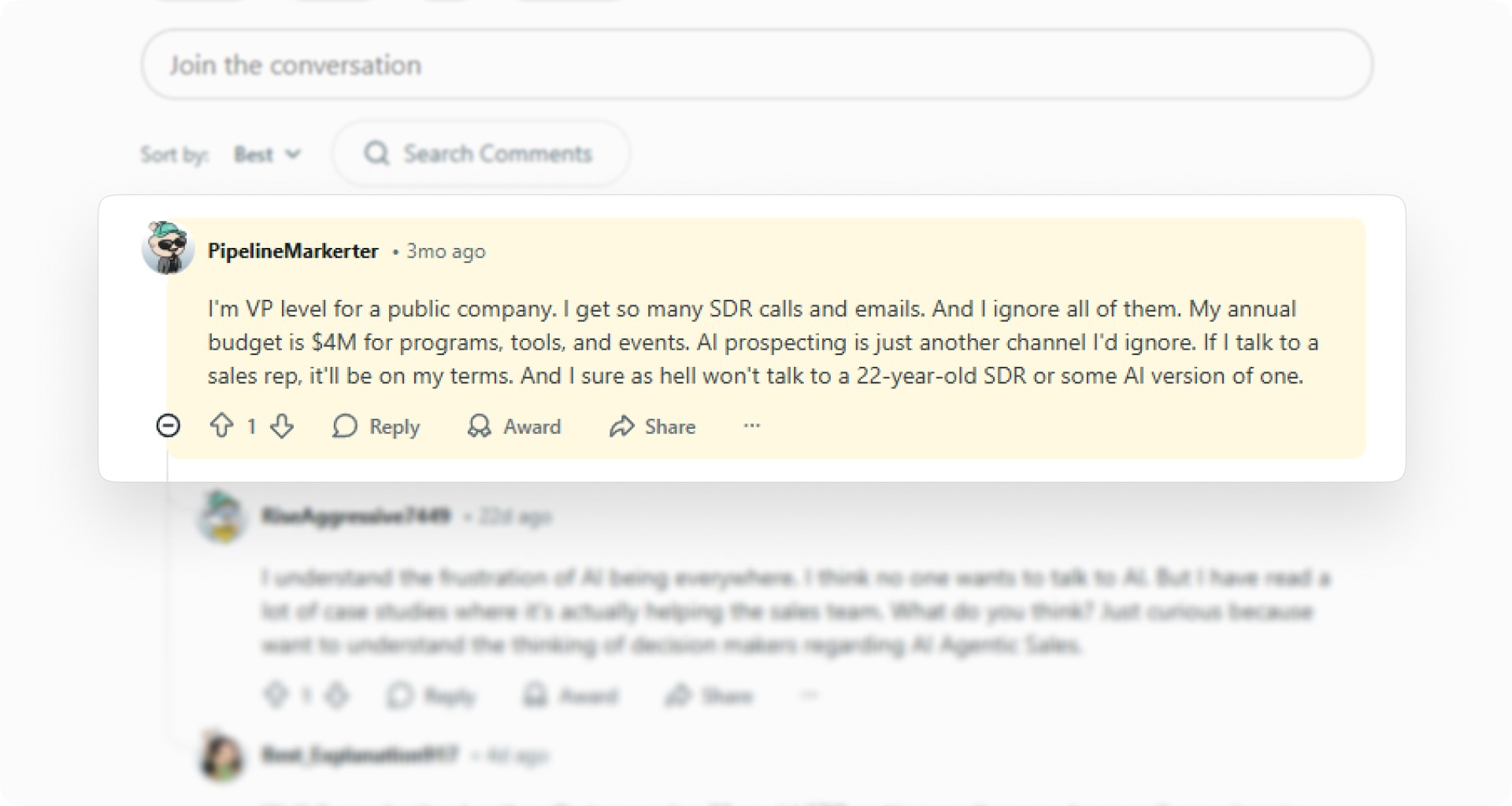
This means the buyers who matter most — like the VPs and directors with actual budget authority — aren't interested. They were already tired of talking to junior SDRs, let alone AI pretending to be one. Cold AI outreach rarely makes that list.

This means the buyers who matter most — like the VPs and directors with actual budget authority — aren't interested. They were already tired of talking to junior SDRs, let alone AI pretending to be one. Cold AI outreach rarely makes that list.

Source: Reddit

Next, the market got saturated. When everyone uses the same tools with the same timing optimization, buyers see the pattern. Multiple AI SDRs hit the same inbox daily with similar hooks. It's not that buyers refuse to engage with AI — they use it on websites, in demos, during research. They just won't engage with cold, low-context AI that's clearly blasting hundreds of people.

Finally, the ROI pitch fell flat. Vendors sold this as "replace your SDR for $2K a month." But modern outbound isn't about volume — it's about account-level judgment. You need to multi-thread across an org, adjust strategy based on who responds, and interpret fragmented signals across channels.

Next, the market got saturated. When everyone uses the same tools with the same timing optimization, buyers see the pattern. Multiple AI SDRs hit the same inbox daily with similar hooks. It's not that buyers refuse to engage with AI — they use it on websites, in demos, during research. They just won't engage with cold, low-context AI that's clearly blasting hundreds of people.

Finally, the ROI pitch fell flat. Vendors sold this as "replace your SDR for $2K a month." But modern outbound isn't about volume — it's about account-level judgment. You need to multi-thread across an org, adjust strategy based on who responds, and interpret fragmented signals across channels.

The Outbound Ceiling

Outbound is also hitting technical constraints. Inbox filters keep getting tighter. Google, for example, is rolling out AI inbox filtering. It filters based on sender relationships, email frequency, and inferred importance. Cold outreach from unknown senders — especially high-volume AI-generated messages — gets deprioritized by default.

Reaching a prospect now requires rotating domains and IPs, carefully shaping language to avoid sales signals, working around ESP and third-party filters, and staying compliant — all before the message is even delivered.

So AI SDRs built for volume hit that wall faster than the extra emails turn into real pipeline.

The inbound advantage: Why context changes everything

The inbound advantage: Why context changes everything

According to Gartner, 75% of buyers prefer a rep-free experience early on. But that creates a problem: sellers lose visibility into what's happening before a lead reaches them. Inbound AI agents solve this by sitting in the middle — less pushy than a sales rep, but more useful than a static form.The difference with inbound is that AI starts with declared intent. The buyer initiates contact. They filled out a form, requested a demo, or asked a question. That gives the AI something real to work with: self-reported data, pages they visited, time spent on site, and previous conversations with support or chat. There's actual context to start from, so personalization isn't forced. That context lets AI make decisions, not just execute automation. It's reading urgency in the language, specific pain points mentioned, and where the buyer is in their process. Based on that, it routes. Prospects who aren't ready go into nurturing sequences. Hot leads — ones showing real urgency or fit — go straight to sales.This is why inbound AI works better. It has two layers of information: What it knows about the company, such as the product catalogue, pricing, use cases, and historical customer conversationsWhat it knows about the specific buyer, like their role, their problem, and their timeline. It's not guessing. It's not blasting hundreds of people, hoping one responds. It's operating with enough signal to actually accelerate your pipeline

According to Gartner, 75% of buyers prefer a rep-free experience early on. But that creates a problem: sellers lose visibility into what's happening before a lead reaches them. Inbound AI agents solve this by sitting in the middle — less pushy than a sales rep, but more useful than a static form.The difference with inbound is that AI starts with declared intent. The buyer initiates contact. They filled out a form, requested a demo, or asked a question. That gives the AI something real to work with: self-reported data, pages they visited, time spent on site, and previous conversations with support or chat. There's actual context to start from, so personalization isn't forced. That context lets AI make decisions, not just execute automation. It's reading urgency in the language, specific pain points mentioned, and where the buyer is in their process. Based on that, it routes. Prospects who aren't ready go into nurturing sequences. Hot leads — ones showing real urgency or fit — go straight to sales.This is why inbound AI works better. It has two layers of information: What it knows about the company, such as the product catalogue, pricing, use cases, and historical customer conversationsWhat it knows about the specific buyer, like their role, their problem, and their timeline. It's not guessing. It's not blasting hundreds of people, hoping one responds. It's operating with enough signal to actually accelerate your pipeline

The buyer told you why they're here. The AI just has to act on it correctly.

How AI works better when buyers start the conversation

  • The advantage isn't that inbound AI is smarter. It's that buyers give it permission to be useful.

    When someone fills out a form or asks a question, they're providing structured input. The AI can compare that language against patterns from previous successful buyers — technical vocabulary, urgency markers, and even organizational framing. For example:

    • A buyer asking about API rate limits is signaling readiness differently than someone asking "what does your product do?" 

    • Someone saying "we're evaluating options for Q2" is speaking for a team with a timeline. "I'm curious about this" is individual exploration. 

    The AI isn't detecting authority directly — that often gets obscured — but it can infer buying posture from how people frame their requests.

    Moreover, because the buyer initiated contact, the AI has permission to ask follow-up questions. That's what makes intent easy to gauge. It can clarify use case, confirm timeline, surface concerns about implementation or compatibility. These are questions that would feel intrusive in cold outreach but are expected when someone asks for help.

    So, here, routing happens as a consequence. A security buyer with compliance questions goes to one sales rep. A marketing ops lead evaluating automation goes to another. The AI isn't guessing from a LinkedIn profile. Rather, it matches stated needs to the right expertise.

    This works because inbound workflows are bounded and patterned:

    • A demo request follows a different path than a pricing question. 

    • An early-stage education inquiry gets routed to content or a junior rep. 

    • A late-stage evaluation with specific technical requirements goes straight to a senior AE. 

    The inputs are structured so the decision points follow known patterns. This makes it easy for AI to learn from how top performers handled similar cases and replicate that approach.

Outbound doesn't have this structure. There are playbooks — ABM frameworks, persona-based messaging, account scoring — but the signal is unreliable. Strategy changes mid-conversation. Not to mention that feedback loops are slow to nonexistent. 

Put simply, inbound starts with information, while outbound starts with assumptions.

What the Vercel experiment proved about automating inbound

Vercel replaced its 10-person inbound SDR team with AI. Engineers shadowed the top performer for six weeks, documenting the process: how to qualify a lead, what data sources to check, how to craft a reply, and when to escalate to support.

The AI now handles the full workflow:

  • Reviews inbound messages and weeds out spam

  • Cross-checks company details through LinkedIn and Google

  • Queries internal databases

  • Drafts personalized responses

  • Routes support inquiries automatically

All drafts are posted in Slack, where a manager reviews output, corrects tone, and provides feedback. The agent learns over time. Lead processing, which used to take up to 50 minutes manually, now takes minutes. One person supervises the agent. The other nine moved to outbound prospecting.

Vercel's COO said their guiding principle was identifying workflows that were "replicable and deterministic." Inbound qualified because the process could be documented. The nine SDRs moved to outbound because that's typically where documentation falters.

The moat isn’t automation — it’s buyer intent intelligence

The moat isn’t automation — it’s buyer intent intelligence

Vercel automated the workflow, but the real advantage wasn’t speed. It captured what buyers actually said when they first reached out — before sales could shape the conversation. That first message is the clearest signal you get.

Vercel automated the workflow, but the real advantage wasn’t speed. It captured what buyers actually said when they first reached out — before sales could shape the conversation. That first message is the clearest signal you get.

And yet, only 7% of companies respond within five minutes of a prospect submitting a form. Nearly 50% don’t respond within 5 business days.

Automation itself is no longer a differentiator. Any company can deploy an AI agent to handle inbound. What separates teams is what they do with the intent data generated by those conversations.

Buyer intent intelligence isn’t lead scoring, firmographics or job titles. It’s the signals inside the conversation: 

  • The specific questions buyers ask

  • The concerns they surface indirectly

  • The language that reveals their emotions

A buyer asking about SSO implementation timelines is in a different place than someone asking whether SSO exists at all. One is comparing vendors. The other is still researching. So when you systematize that listening at the moment buyers first engage, you also preserve how buyers think as they move forward:

  • Early intent gets captured while it’s still raw: Buyers reveal their real problem, language, and assumptions at first contact — how your marketing messages, vendor comparisons, and ChatGPT shortcuts shaped the narrative.

  • Intent compounds as buyers progress: Each interaction adds signal — pricing questions, implementation concerns, deployment risk — creating a continuous picture instead of isolated touchpoints.

  • Accumulated context flows downstream: That preserved intent improves discovery, routing, handoffs, and onboarding, because teams inherit how the buyer thinks, not just who they are.

So the companies winning at inbound AI are those that build systems that remember how buyers think from the first message onward.

Automation itself is no longer a differentiator. Any company can deploy an AI agent to handle inbound. What separates teams is what they do with the intent data generated by those conversations.

Buyer intent intelligence isn’t lead scoring, firmographics or job titles. It’s the signals inside the conversation: 

  • The specific questions buyers ask

  • The concerns they surface indirectly

  • The language that reveals their emotions

A buyer asking about SSO implementation timelines is in a different place than someone asking whether SSO exists at all. One is comparing vendors. The other is still researching. So when you systematize that listening at the moment buyers first engage, you also preserve how buyers think as they move forward:

  • Early intent gets captured while it’s still raw: Buyers reveal their real problem, language, and assumptions at first contact — how your marketing messages, vendor comparisons, and ChatGPT shortcuts shaped the narrative.

  • Intent compounds as buyers progress: Each interaction adds signal — pricing questions, implementation concerns, deployment risk — creating a continuous picture instead of isolated touchpoints.

  • Accumulated context flows downstream: That preserved intent improves discovery, routing, handoffs, and onboarding, because teams inherit how the buyer thinks, not just who they are.

So the companies winning at inbound AI are those that build systems that remember how buyers think from the first message onward.

AI demo agents and intent-driven lead engagement

AI demo agents — like Path AI by Layerpath — sit between initial interest and human sales. A buyer lands on your site, shows intent, and instead of waiting days for a callback, they interact with an agent that can actually show them the product.

These aren't chatbots following scripts. They're autonomous agents trained on your product documentation, support history, and sales materials. They engage visitors in natural language — some through text, others through voice — and adapt based on what the buyer says.

Here's how it works:

  •  A visitor asks about a specific feature or use case. 

  • The agent responds with context pulled from your knowledge base, walks them through relevant parts of the product, and asks clarifying questions to understand fit. 

The conversion mechanism is hyper-specific answers tied to the buyer's context. Instead of generic responses, the agent references their industry, role, or stated problem. A security buyer asking about compliance gets a walkthrough of your security controls. A marketing ops lead asking about integrations sees your API capabilities. The answers feel relevant because they are.

It's not broadcasting features but having a two-way conversation. This matters more now because buyers often arrive knowing more — or thinking they know more — than sellers. According to HubSpot’s 2025 sales trends report, 74% of sellers believe tools like ChatGPT have made it easier for buyers to research products. This permanently raises the bar for sales conversations.

Buyers are forming opinions, narrowing options, and defining requirements before they ever talk to a human. That creates a new problem: buyers don’t just arrive informed — they sometimes arrive misinformed.

Static webpages can’t correct that. A trained AI demo agent can. Unlike static content, a demo agent can engage immediately, adapt to the buyer’s context, and address misconceptions in real time, before they harden into objections.

And while this happens, the agent is capturing intent intelligence. It tracks which features the buyer explores, what questions they ask, how technical their language is, and whether they're speaking for a team or browsing alone.

That data gets passed to sales with full context — not just "this person clicked around," but "this person is evaluating SSO implementation timelines for a 200-person engineering team."

AI demo agents also solve the timing problem:

  • In the traditional flow, a buyer fills out a form, waits one to three days for SDR outreach, then spends another several days in back-and-forth scheduling before a first demo happens. 

  • With demo agents, engagement is immediate. Qualification happens on the website, in real time. High-intent prospects are routed to sales within hours, while lower-intent visitors enter appropriate nurturing sequences.

In short, it’s filtering the noise and handing qualified, contextualized leads to reps who can close. Buyers get immediate answers. Sales gets real pipeline. That's the advantage.

The 2026 sales funnel: AI handles inbound, humans own outbound

The 2026 sales funnel: AI handles inbound, humans own outbound

Inbound is going machine-first because buyers hand you what AI needs to work: context, permission, and structured problems to solve. AI takes that and runs — capturing what buyers care about, how their thinking changes, where concerns show up. Sales gets that intelligence, not just a name and email.

Outbound remains human-led for the opposite reason. There is no initial context to reason from and no permission to ask clarifying questions. Generative AI is useful here as an assistive layer—researching accounts, drafting outreach, managing follow-ups — but fully autonomous AI SDRs struggle because the conditions they need don’t exist. There is no declared intent to analyze and no repeatable workflow that holds across an entire prospect list.

This distinction explains where agentic systems actually make sense. Inbound agents work when they engage buyers at the moment interest is expressed and use that interaction to qualify and route in real time. That’s the role Path AI plays. 

It operates as a conversational demo agent, engaging visitors in natural language and responding with answers grounded in product documentation and internal knowledge. As the conversation unfolds, it qualifies implicitly — detecting depth, urgency, and buying posture. The outcome isn’t fewer human conversations. It’s better ones—because sales teams start with intent, not guesswork.

Curious to learn more? Sign up for early access, and see firsthand how AI voice demo agents can drive real revenue impact. And if you’d like to geek out about the potential of agentic AI and conversational AI demos, you can schedule a 30-minute call with Vinay, our founder.

Frequently asked questions (FAQs)

Frequently asked questions (FAQs)

1. What buyer signals can AI reliably capture during inbound conversations?

AI captures intent signals embedded in conversation: which features buyers probe, how technical their questions are, whether they reference timelines, teams, or constraints, and when they compare alternatives. These signals indicate readiness and use case, not just interest.

2. Why do outbound AI SDRs increase connect rates but fail to convert?

Outbound AI improves reach by optimizing timing and volume, but it lacks buyer intent. Without permission or context, conversations stall because the AI cannot run real discovery or progress a deal.

3. Why do AI agents perform better on inbound than outbound?

3. Why do AI agents perform better on inbound than outbound?

When buyers reach out first, AI can react to what they actually say and ask. In outbound, there’s no signal to work from, so the AI is guessing what might matter instead of responding to something real.

4. What are AI demo agents, and how do they support inbound sales functions?

AI demo agents are basically conversational agents that talk to buyers when they land on your site. Buyers ask questions, and the agent answers them by pulling the right docs, videos, or interactive demos—showing what matters instead of dumping everything. While that’s happening, it’s also qualifying interest, so sales reps only step in when the buyer is actually ready.

The B2B sales world is splitting in two directions, and the numbers tell an interesting story. SaaStr claims that 90% of outbound and 95% of inbound sales tasks can be automated. It further states 36% of B2B companies are already cutting their SDR teams. 

The question is where to deploy AI. Some companies are automating outbound — using AI to handle cold emails at scale while keeping humans on inbound leads. Others are doing the opposite. Vercel, for instance, automated inbound and moved most humans to outbound sales teams.

Both strategies claim efficiency. Only one consistently scales.

So where does AI actually fit? In this article, we’ll look closely at how agentic AI is being used in inbound and outbound sales today — what’s working, what isn’t — so you know how to think about investing in sales AI without wasting budget — or buyer trust.

The two places where agentic AI entered sales

Inbound and outbound were the obvious starting points for sales automation. Both involve high-volume, repeatable work with recognizable patterns — exactly the kind of environment where AI automation is expected to perform well.

Outbound AI focused on three bottlenecks: research, volume, and timing. Human SDRs spend hours gathering context — reviewing company websites, scanning LinkedIn profiles, and searching for relevant hooks — before sending a single message.

They then manage follow-ups across hundreds of prospects, hoping to land in the narrow window when a buyer might respond. Miss that window, and the message disappears. AI compresses this entire workflow: it researches faster, reaches more prospects, and optimizes outreach timing at scale.

Inbound AI addressed different constraints: speed and qualification. Delays between a form fill or demo request and the first response increase drop-off. Traditional lead scoring relies on firmographics and titles, but ignores intent. Inbound AI evaluates actual buyer behavior — how they engaged — and routes conversations based on that signal.

The core difference comes down to who starts the conversation. Outbound AI initiates — it's reaching out cold, so it focuses on relevance and timing. Inbound AI continues — someone already raised their hand, so it's about understanding what they want and moving them forward without friction.

That difference in approach shapes what each type of AI can actually do — and what results companies see when they deploy them.

The two places where agentic AI entered sales

Inbound and outbound were the obvious starting points for sales automation. Both involve high-volume, repeatable work with recognizable patterns — exactly the kind of environment where AI automation is expected to perform well.

Outbound AI focused on three bottlenecks: research, volume, and timing. Human SDRs spend hours gathering context — reviewing company websites, scanning LinkedIn profiles, and searching for relevant hooks — before sending a single message.

They then manage follow-ups across hundreds of prospects, hoping to land in the narrow window when a buyer might respond. Miss that window, and the message disappears. AI compresses this entire workflow: it researches faster, reaches more prospects, and optimizes outreach timing at scale.

Inbound AI addressed different constraints: speed and qualification. Delays between a form fill or demo request and the first response increase drop-off. Traditional lead scoring relies on firmographics and titles, but ignores intent. Inbound AI evaluates actual buyer behavior — how they engaged — and routes conversations based on that signal.

The core difference comes down to who starts the conversation. Outbound AI initiates — it's reaching out cold, so it focuses on relevance and timing. Inbound AI continues — someone already raised their hand, so it's about understanding what they want and moving them forward without friction.

That difference in approach shapes what each type of AI can actually do — and what results companies see when they deploy them.

The outbound AI SDR promise — and why it’s breaking down

At first, the numbers looked great. Connect rates climbed. Activity metrics doubled, sometimes tripled. AI SDRs sent more messages and got more opens than human teams ever could. But most of those didn’t translate into meetings or pipeline.

The issue wasn’t personalization capability, it was context and permission. AI could retrieve data and reference it well — sometimes too well. It would throw in a LinkedIn post from months earlier or mention a prospect’s local weather. But without shared context, those details felt invasive rather than useful.

This means the buyers who matter most — like the VPs and directors with actual budget authority — aren't interested. They were already tired of talking to junior SDRs, let alone AI pretending to be one. Cold AI outreach rarely makes that list.

Next, the market got saturated. When everyone uses the same tools with the same timing optimization, buyers see the pattern. Multiple AI SDRs hit the same inbox daily with similar hooks. It's not that buyers refuse to engage with AI — they use it on websites, in demos, during research. They just won't engage with cold, low-context AI that's clearly blasting hundreds of people.

Finally, the ROI pitch fell flat. Vendors sold this as "replace your SDR for $2K a month." But modern outbound isn't about volume — it's about account-level judgment. You need to multi-thread across an org, adjust strategy based on who responds, and interpret fragmented signals across channels.

Without buyer-initiated context, AI personalization starts feeling awkward and intrusive rather than helpful.

The Outbound Ceiling

Outbound is also hitting technical constraints. Inbox filters keep getting tighter. Google, for example, is rolling out AI inbox filtering. It filters based on sender relationships, email frequency, and inferred importance. Cold outreach from unknown senders — especially high-volume AI-generated messages — gets deprioritized by default.

Reaching a prospect now requires rotating domains and IPs, carefully shaping language to avoid sales signals, working around ESP and third-party filters, and staying compliant — all before the message is even delivered.

So AI SDRs built for volume hit that wall faster than the extra emails turn into real pipeline.

Source: Reddit

The inbound advantage: Why context changes everything

According to Gartner, 75% of buyers prefer a rep-free experience early on. But that creates a problem: sellers lose visibility into what's happening before a lead reaches them. Inbound AI agents solve this by sitting in the middle — less pushy than a sales rep, but more useful than a static form.

The difference with inbound is that AI starts with declared intent. The buyer initiates contact. They filled out a form, requested a demo, or asked a question. That gives the AI something real to work with: self-reported data, pages they visited, time spent on site, and previous conversations with support or chat. 

There's actual context to start from, so personalization isn't forced. That context lets AI make decisions, not just execute automation. It's reading urgency in the language, specific pain points mentioned, and where the buyer is in their process. Based on that, it routes. Prospects who aren't ready go into nurturing sequences. Hot leads — ones showing real urgency or fit — go straight to sales.

This is why inbound AI works better. It has two layers of information: 

  • What it knows about the company, such as the product catalogue, pricing, use cases, and historical customer conversations

  • What it knows about the specific buyer, like their role, their problem, and their timeline. 

It's not guessing. It's not blasting hundreds of people, hoping one responds. It's operating with enough signal to actually accelerate your pipeline.

The buyer told you why they're here. The AI just has to act on it correctly.

How AI works better when buyers start the conversation

  • The advantage isn't that inbound AI is smarter. It's that buyers give it permission to be useful.

    When someone fills out a form or asks a question, they're providing structured input. The AI can compare that language against patterns from previous successful buyers — technical vocabulary, urgency markers, and even organizational framing. For example:

    • A buyer asking about API rate limits is signaling readiness differently than someone asking "what does your product do?" 

    • Someone saying "we're evaluating options for Q2" is speaking for a team with a timeline. "I'm curious about this" is individual exploration. 

    The AI isn't detecting authority directly — that often gets obscured — but it can infer buying posture from how people frame their requests.

    Moreover, because the buyer initiated contact, the AI has permission to ask follow-up questions. That's what makes intent easy to gauge. It can clarify use case, confirm timeline, surface concerns about implementation or compatibility. These are questions that would feel intrusive in cold outreach but are expected when someone asks for help.

    So, here, routing happens as a consequence. A security buyer with compliance questions goes to one sales rep. A marketing ops lead evaluating automation goes to another. The AI isn't guessing from a LinkedIn profile. Rather, it matches stated needs to the right expertise.

    This works because inbound workflows are bounded and patterned:

    • A demo request follows a different path than a pricing question. 

    • An early-stage education inquiry gets routed to content or a junior rep. 

    • A late-stage evaluation with specific technical requirements goes straight to a senior AE. 

    The inputs are structured so the decision points follow known patterns. This makes it easy for AI to learn from how top performers handled similar cases and replicate that approach.

Outbound doesn't have this structure. There are playbooks — ABM frameworks, persona-based messaging, account scoring — but the signal is unreliable. Strategy changes mid-conversation. Not to mention that feedback loops are slow to nonexistent. 

Put simply, inbound starts with information, while outbound starts with assumptions.

What the Vercel experiment proved about automating inbound

Vercel replaced its 10-person inbound SDR team with AI. Engineers shadowed the top performer for six weeks, documenting the process: how to qualify a lead, what data sources to check, how to craft a reply, and when to escalate to support.

The AI now handles the full workflow:

  • Reviews inbound messages and weeds out spam

  • Cross-checks company details through LinkedIn and Google

  • Queries internal databases

  • Drafts personalized responses

  • Routes support inquiries automatically

All drafts are posted in Slack, where a manager reviews output, corrects tone, and provides feedback. The agent learns over time. Lead processing, which used to take up to 50 minutes manually, now takes minutes. One person supervises the agent. The other nine moved to outbound prospecting.

Vercel's COO said their guiding principle was identifying workflows that were "replicable and deterministic." Inbound qualified because the process could be documented. The nine SDRs moved to outbound because that's typically where documentation falters.

The moat isn’t automation — it’s buyer intent intelligence

Vercel automated the workflow, but the real advantage wasn’t speed. It captured what buyers actually said when they first reached out — before sales could shape the conversation. That first message is the clearest signal you get.

And yet, only 7% of companies respond within five minutes of a prospect submitting a form. Nearly 50% don’t respond within 5 business days.

Automation itself is no longer a differentiator. Any company can deploy an AI agent to handle inbound. What separates teams is what they do with the intent data generated by those conversations.

Buyer intent intelligence isn’t lead scoring, firmographics or job titles. It’s the signals inside the conversation: 

  • The specific questions buyers ask

  • The concerns they surface indirectly

  • The language that reveals their emotions

A buyer asking about SSO implementation timelines is in a different place than someone asking whether SSO exists at all. One is comparing vendors. The other is still researching. So when you systematize that listening at the moment buyers first engage, you also preserve how buyers think as they move forward:

  • Early intent gets captured while it’s still raw: Buyers reveal their real problem, language, and assumptions at first contact — how your marketing messages, vendor comparisons, and ChatGPT shortcuts shaped the narrative.

  • Intent compounds as buyers progress: Each interaction adds signal — pricing questions, implementation concerns, deployment risk — creating a continuous picture instead of isolated touchpoints.

  • Accumulated context flows downstream: That preserved intent improves discovery, routing, handoffs, and onboarding, because teams inherit how the buyer thinks, not just who they are.

So the companies winning at inbound AI are those that build systems that remember how buyers think from the first message onward.

AI demo agents and intent-driven lead engagement

AI demo agents — like Path AI by Layerpath — sit between initial interest and human sales. A buyer lands on your site, shows intent, and instead of waiting days for a callback, they interact with an agent that can actually show them the product.

These aren't chatbots following scripts. They're autonomous agents trained on your product documentation, support history, and sales materials. They engage visitors in natural language — some through text, others through voice — and adapt based on what the buyer says.

Here's how it works:

  •  A visitor asks about a specific feature or use case. 

  • The agent responds with context pulled from your knowledge base, walks them through relevant parts of the product, and asks clarifying questions to understand fit. 

The conversion mechanism is hyper-specific answers tied to the buyer's context. Instead of generic responses, the agent references their industry, role, or stated problem. A security buyer asking about compliance gets a walkthrough of your security controls. A marketing ops lead asking about integrations sees your API capabilities. The answers feel relevant because they are.

It's not broadcasting features but having a two-way conversation. This matters more now because buyers often arrive knowing more — or thinking they know more — than sellers. According to HubSpot’s 2025 sales trends report, 74% of sellers believe tools like ChatGPT have made it easier for buyers to research products. This permanently raises the bar for sales conversations.

Buyers are forming opinions, narrowing options, and defining requirements before they ever talk to a human. That creates a new problem: buyers don’t just arrive informed — they sometimes arrive misinformed.

Static webpages can’t correct that. A trained AI demo agent can. Unlike static content, a demo agent can engage immediately, adapt to the buyer’s context, and address misconceptions in real time, before they harden into objections.

And while this happens, the agent is capturing intent intelligence. It tracks which features the buyer explores, what questions they ask, how technical their language is, and whether they're speaking for a team or browsing alone.

That data gets passed to sales with full context — not just "this person clicked around," but "this person is evaluating SSO implementation timelines for a 200-person engineering team."

AI demo agents also solve the timing problem:

  • In the traditional flow, a buyer fills out a form, waits one to three days for SDR outreach, then spends another several days in back-and-forth scheduling before a first demo happens. 

  • With demo agents, engagement is immediate. Qualification happens on the website, in real time. High-intent prospects are routed to sales within hours, while lower-intent visitors enter appropriate nurturing sequences.

In short, it’s filtering the noise and handing qualified, contextualized leads to reps who can close. Buyers get immediate answers. Sales gets real pipeline. That's the advantage.

The 2026 sales funnel: AI handles inbound, humans own outbound

Inbound is going machine-first because buyers hand you what AI needs to work: context, permission, and structured problems to solve. AI takes that and runs — capturing what buyers care about, how their thinking changes, where concerns show up. Sales gets that intelligence, not just a name and email.

Outbound remains human-led for the opposite reason. There is no initial context to reason from and no permission to ask clarifying questions. Generative AI is useful here as an assistive layer—researching accounts, drafting outreach, managing follow-ups — but fully autonomous AI SDRs struggle because the conditions they need don’t exist. There is no declared intent to analyze and no repeatable workflow that holds across an entire prospect list.

This distinction explains where agentic systems actually make sense. Inbound agents work when they engage buyers at the moment interest is expressed and use that interaction to qualify and route in real time. That’s the role Path AI plays. 

It operates as a conversational demo agent, engaging visitors in natural language and responding with answers grounded in product documentation and internal knowledge. As the conversation unfolds, it qualifies implicitly — detecting depth, urgency, and buying posture. The outcome isn’t fewer human conversations. It’s better ones—because sales teams start with intent, not guesswork.

Curious to learn more? Sign up for early access, and see firsthand how AI voice demo agents can drive real revenue impact. And if you’d like to geek out about the potential of agentic AI and conversational AI demos, you can schedule a 30-minute call with Vinay, our founder.

Frequently asked questions (FAQs)

1. What buyer signals can AI reliably capture during inbound conversations?

AI captures intent signals embedded in conversation: which features buyers probe, how technical their questions are, whether they reference timelines, teams, or constraints, and when they compare alternatives. These signals indicate readiness and use case, not just interest.

2. Why do outbound AI SDRs increase connect rates but fail to convert?

Outbound AI improves reach by optimizing timing and volume, but it lacks buyer intent. Without permission or context, conversations stall because the AI cannot run real discovery or progress a deal.

3. Why do AI agents perform better on inbound than outbound?

When buyers reach out first, AI can react to what they actually say and ask. In outbound, there’s no signal to work from, so the AI is guessing what might matter instead of responding to something real.

4. What are AI demo agents, and how do they support inbound sales functions?

AI demo agents are basically conversational agents that talk to buyers when they land on your site. Buyers ask questions, and the agent answers them by pulling the right docs, videos, or interactive demos—showing what matters instead of dumping everything. While that’s happening, it’s also qualifying interest, so sales reps only step in when the buyer is actually ready.

© Copyright 2025, Layerpath Inc.

© Copyright 2025, Layerpath Inc.

© Copyright 2025, Layerpath Inc.