
This guide breaks down 10 tools built to solve those exact failures. These tools surface intent earlier, qualify buyers through real behavior, unify GTM data, speed up routing, and turn product experiences into pipeline.
TL;DR: The best demand generation software at a glance
| Tool | Category | Best for | Pricing |
|---|---|---|---|
| Layerpath | Interactive demos | Demand teams converting anonymous traffic into qualified pipeline through ungated product experiences | Studio: $129/mo |
| Lovable | AI app builder | Teams needing interactive tools, calculators, and landing pages without dev resources | Free plan; Paid starts at $25/mo |
| Sequel.io | Event-based demand gen | Teams running webinars/meetups on their own domain with full data ownership | Starts at $950/mo |
| Default | Inbound orchestration platform | Teams needing fast qualification, clean CRM data, and reliable routing | Starts at $750/mo + $45/user (annual billing) |
| Relay.app | AI agents and workflow automation | Teams automating research, qualification, and repetitive GTM tasks | Free plan (500 credits); Paid starts at $38/mo |
| AirOps | Content engineering and SEO/AI search visibility | Content-led teams optimizing pages for SEO and AI search surfaces | Custom pricing |
| Reachdesk | Global gifting and swag automation | Teams using gifting to improve outreach, pipeline movement, and engagement | Starts at $20,000/year |
| PartnerStack | Partner management | GTM teams scaling affiliates, co-selling, resellers, and influencer programs | Custom pricing |
| HockeyStack | GTM intelligence | Teams needing clean, unified GTM data and AI insights/actions | Starts at $2,200/mo; add-ons cost extra |
| VWO | Experimentation and personalization | PLG and demand teams optimizing conversion with high-volume experiments | Free plan; Paid typically ~$249/product/mo |
Why your demand generation tech stack needs an overhaul
Demand generation is the engine that builds momentum across the entire buying journey. That means three things: showing up early with relevance, capturing the signals that indicate movement, and giving buyers what they need to drive internal consensus.
And in 2026, that journey is anything but linear. You’re selling into committees with overlapping priorities, evaluation windows that open and close without warning, and buyers who often complete 60–70% of their research before they ever talk to you.
This is exactly where the demand gen stack matters:
- Identifying who’s actually in-market: intent data, website behavior analytics, account scoring, and enrichment layers that separate real buyers from passive researchers.
- Engaging multiple stakeholders at once: Conversational AI agents, ABM ad systems, and content delivery that adapts to each persona and stage.
- Giving sales signal instead of noise: Unified activity timelines, account-level engagement views, and automated routing so sales knows where momentum is building and who is driving it.
The shift from interruption-based to experience-based demand generation
Buyers changed the rules. In Informa TechTarget’s 2025 B2B Demand Generation Predictions Survey, 28% of marketers said they were worried about oversaturated markets. A further 24% mention buyers are becoming more distrustful of marketing and advertising.
Most buyers are filtering you out—auto-archiving outbound, scrolling past ads, and refusing to hand over their contact info for a PDF.
The old playbook was built on interruption: batch-and-blast emails, gated content, retargeting people until they opted out. It relied on the assumption that enough noise eventually turns into pipeline.
That means publishing research that actually informs next-quarter decisions—not generic “state of the industry” PDFs. It means building communities where operators learn from each other, not where you push announcements. And it increasingly means giving people a real sense of your product before they ever talk to sales.
Non-gated product experiences are also becoming the expectation: interactive demos, guided sandboxes, AI demo agents that show real workflows, and lightweight “try it now” paths that let prospects validate fit on their own terms.
10 demand generation tools for B2B marketers in 2026
The modern demand engine relies on tools that surface intent earlier, engage accounts more intelligently, and give sales a clearer picture of where momentum is building. The list below focuses on tech that does exactly that.
1. Layerpath
Best for: Demand teams that need to convert anonymous website visits into qualified pipeline without inflating SDR work.
Layerpath turns software knowledge into reusable interactive walkthroughs, step-by-step guides, and training videos. Start by recording a browser workflow, uploading images or video, choosing saved media, or importing a Loom or YouTube link. Layerpath turns the source into editable guidance you can deploy across your website, paid programs, sales enablement, or support content.
How Layerpath supports demand generation teams
Layerpath turns product exposure into intent data. Instead of gating demos behind forms, you let prospects interact with your website — and product — directly and capture behavioral signals that tell you who's actually buying. This includes:
- Ungated product experiences: Layerpath turns a workflow into an interactive walkthrough, a training video, and a step-by-step guide. You deploy these across your website, paid programs, and content without introducing gates. Engagement is measured through real behavior—what people view and how deep they explore.
Layerpath key features
Layerpath
- Interactive editor: Create polished demos with tools for trimming, zooming, highlighting, and building branched paths.
- AI-assisted enhancements: Generate voiceovers, captions, and text refinements to improve clarity without extra production work.
- Playlists and sequencing: Combine demos and videos into guided flows for education or pre-demo prep.
- Embedded CTAs: Add forms, buttons, or signup prompts directly inside demos when you need to capture details.
Layerpath pricing
Layerpath is priced at $129/month (billed monthly).
2. Lovable
Best for: Demand gen teams that need to ship interactive tools, calculators, and custom landing pages fast without waiting on dev resources.
Source
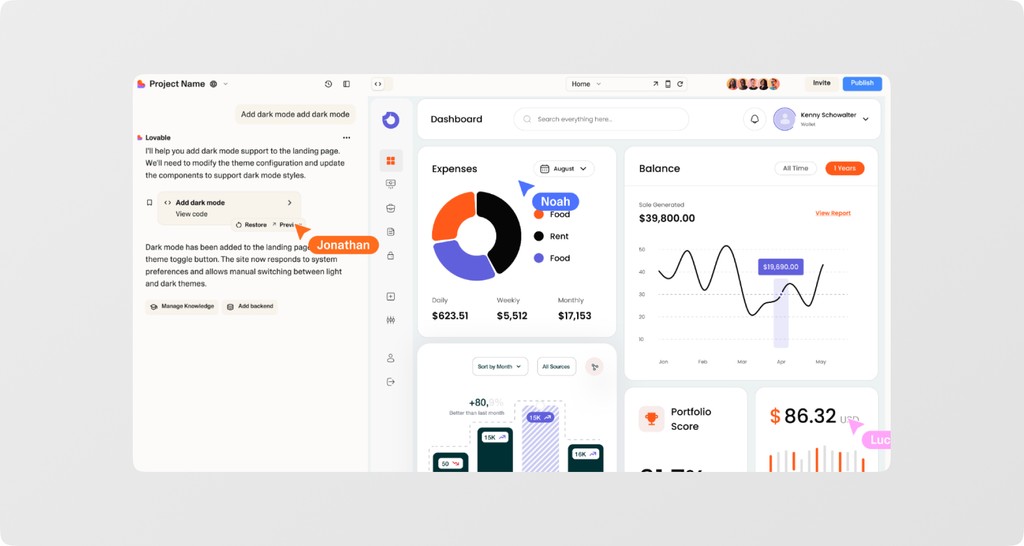
Lovable is an AI app builder that creates full-stack web applications from plain English prompts. Instead of opening dev tickets or waiting on sprint cycles, you describe the tool you want and Lovable generates a working app with frontend, backend, and deployment handled automatically.
Authentication, APIs, and role-based access come preconfigured. The code syncs directly to your GitHub repo, so you own it and can edit it normally. If you need changes, you can modify the code or refine it through more prompts.
How Lovable supports demand generation teams
Interactive tools consistently produce higher-intent signals than static content. Someone who completes a benchmark assessment or enters their numbers into a cost calculator is showing real evaluation behavior. But historically, building these assets required significant engineering time—making them slow to produce and slow to iterate. Lovable removes that friction.
Lovable key features
- Full-stack code generation from plain-language prompts: Lovable converts plain-English descriptions into a working web app automatically.
- No proprietary vendor lock-in: Since it uses open-source technologies and outputs editable code, you retain control over the codebase and can move or extend it freely.
- GitHub integration: The generated code is synced to a GitHub repo so you own it and can manually modify/extend it if needed.
- Custom domains: Projects are published to a default lovable.app domain, with the option to connect your own custom domain or subdomain on paid plans.
Lovable pricing
Lovable offers a Free plan that includes 5 daily credits and 5 lovable.app domains. Paid plans start at $25 per month when billed monthly. They also offer a discount for students with valid university IDs.
3. Sequel.io
Best for: Teams that use events as a core acquisition and acceleration channel and want the entire experience — and dataset — living inside one platform.
Source
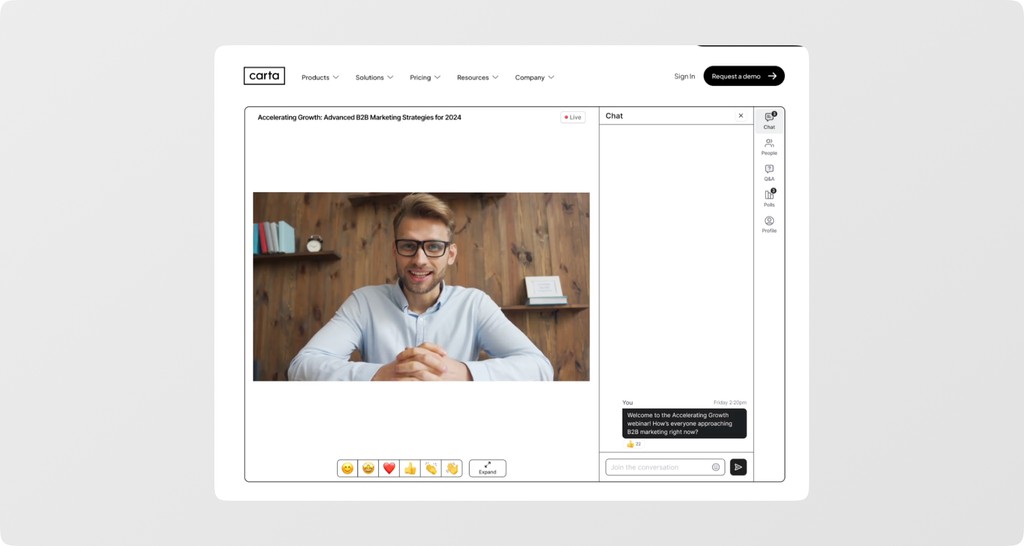
Most webinar tools are built around the event, not the pipeline. You host the session on their domain, your prospects disappear into someone else’s interface, and you get back a CSV that barely maps to your CRM. Sequel approaches the problem from the opposite direction: keep the audience on your site, give you full ownership of the data, and make every event immediately reusable across your demand engine.
And the best part: after the event, it auto-generates content snippets — summaries, clips, transcripts, SEO pages — that you can deploy across paid, nurture, and sales sequences almost immediately.
How Sequel.io supports demand generation teams
Sequel.io is about fixing the operational gap between events and the rest of your GTM motion. When webinars, meetups, and sessions run on your own domain, it can capture the entire content journey behind every registration—not just who attended, but how they moved through your ecosystem before and after the event.
It also gives you a better picture of buying committees by connecting individual activity to the account level so you can see which stakeholders are active, what each person engaged with, and whether their questions, poll responses, and follow-up behavior point to real evaluation.
Sequel.io key features
- Website-embedded webinars: Run live sessions directly on your own domain with iframe, CMS or API embedding.
- AI-powered content repurposing: Automatically turn recordings into blog posts, social clips, SEO-optimized content and other reusable assets.
- Lead scoring: Engagement and behavioral signals are combined with firmographics and passed to your CRM.
- Full-stack event management: Includes registration forms, live streaming, chat/Q&A/polls, and instant on-demand replay delivered without external redirects.
Sequel.io pricing
Sequel.io starts at $950 per month. You can host unlimited sessions but they’re capped at 500 attendees and 3 hours each. Teams needing higher limits or more flexibility can move to a custom plan
4. Default
Best for: Teams that need fast, reliable inbound routing, clean CRM data, and automated scheduling.
Source
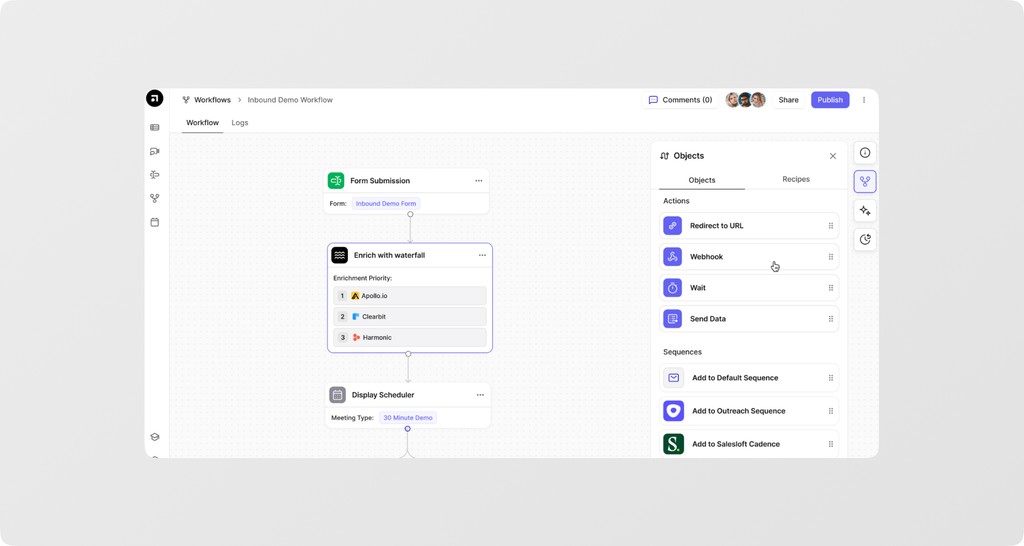
Default is an inbound orchestration platform that handles scheduling, routing, enrichment, website intent, and CRM updates from one place. Instead of stitching together Chili Piper + LeanData + Clearbit + Zapier, Default centralizes everything into a single workflow builder.
Basically, when someone submits a form, Default enriches the lead, matches the account, applies your routing logic, and books a meeting instantly if they qualify. It also identifies anonymous visitors on your site and alerts reps when target accounts are active.
How Default supports demand generation teams
For demand teams, Default solves the biggest leak in the funnel: getting high-intent prospects to the right rep fast. You get a reliable pipeline engine: clean data, faster handoff, and fewer lost opportunities. If you rely on inbound demand generation, this is the platform that keeps it from breaking.
Default key features
- Lead and account routing logic: Route leads automatically based on real-time enrichment, account ownership, geography, territory, team load, or custom rules.
- Website-intent tracking: Detect anonymous company visits on your website and trigger alerts or workflows when target accounts browse, enabling reactive outreach.
- Workflow audits: Track exactly how leads were routed, why decisions were made, monitor workflow execution history, and get alerts on workflow failures or misroutes.
- No-code workflow builder: Drag-and-drop interface to build end-to-end GTM workflows covering routing, scheduling, enrichment, CRM updates.
Default pricing
Default starts at $750 per month (and $45 per additional user), when billed annually. This includes one workflow, basic lead enrichment via Clearbit or Apollo integrations, and 10,000 credits. So quite limiting.
5. Relay.app
Best for: Teams that want AI agents to automate research, qualification, and operational work across their GTM stack.
Source
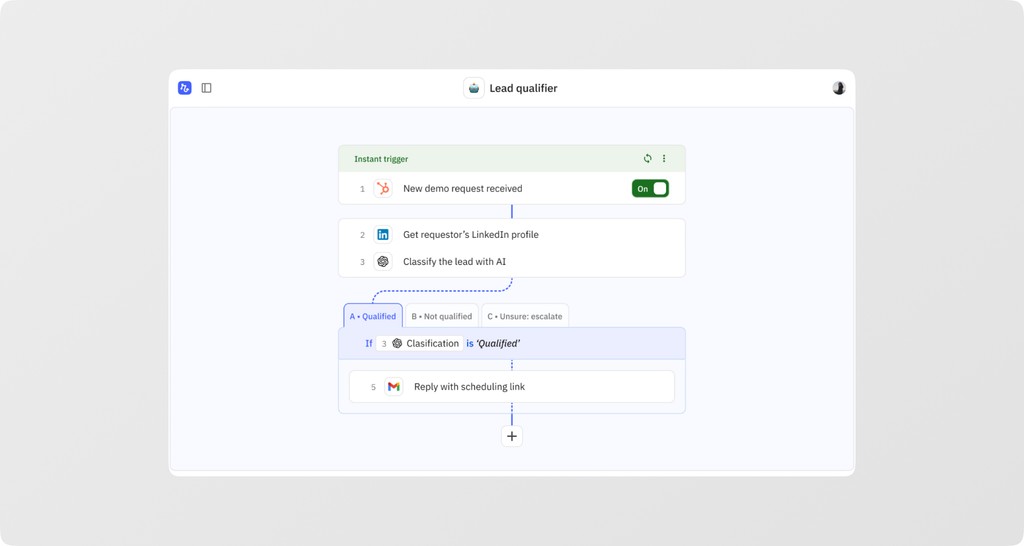
Relay.app is an AI agent platform that lets you create autonomous workflows that run across your apps, data sources, and internal processes. Instead of generating full applications (like Lovable), Relay builds AI agents that pull data, analyze it, write, decide, and take actions inside your existing tools.
These AI agents can qualify demo requests, research companies, write follow-ups from meeting transcripts, track competitors, summarize support issues, create LinkedIn content, identify LinkedIn profiles, or monitor SEO rankings.
How Relay.app supports demand generation teams
Relay.app automates the operational load inside a demand engine. Each agent runs on triggers — form submissions, new CRM records, call transcripts, spreadsheet updates — so tasks that normally take hours happen automatically within seconds.
Relay.app key features
- AI Agent Builder: Create autonomous agents by describing tasks in plain language. Relay.app generates the workflow logic automatically.
- Human-in-the-loop controls: Add approval steps, reviews, or manual inputs before an agent continues execution.
- 100+ native integrations: Connect to tools like Salesforce, HubSpot, Notion, Airtable, Google Workspace, Slack, LinkedIn, Fireflies, Gong, Apollo, Webflow, Intercom, and more.
- Diagnostic logs: See every step an agent took, review failures, and debug workflows with full transparency.
Relay.app pricing
Relay.app offers a free plan with 500 credits per month. Paid plans start at $38 per month when billed monthly. However, they do offer a whopping 50% discount if you subscribe to an annual plan.
6. AirOps
Best for: Best for: Content-led growth teams that need to win visibility in both traditional search and AI search.
Source
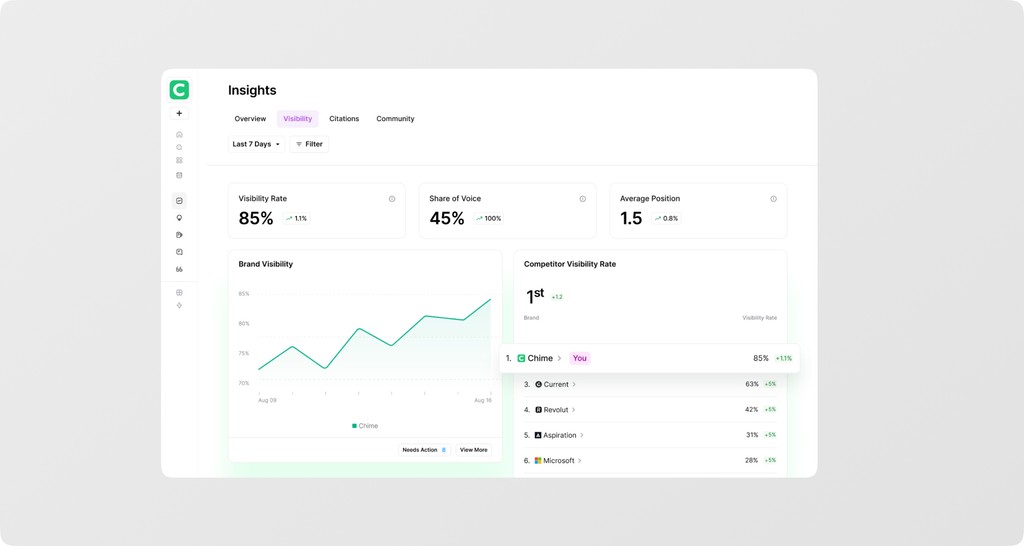
AirOps is a content engineering platform that combines three things usually handled across separate tools: visibility analysis (SEO + AI search), prioritized content opportunities, and workflow execution. The platform is built around two layers:
- Insights, which merges SEO data, AI search citation data, and on-site analytics to surface opportunities
- Action, which executes those opportunities through workflows connected to your brand knowledge, CMS, and human review steps
The result is faster refresh cycles, and content that stays competitive across both SEO and AI search.
AirOps key features
- Opportunity detection: Surfaces topics, pages, and sections that need updates, expansions, or fixes.
- Page360 content diagnostics: Consolidates SEO metrics, AI search visibility, and GA4 data to show content health.
- Workflow engine: Enables structured content refreshes, rewrites, expansions, and updates through multi-step AI workflows.
- Power Agents: Prebuilt agentic workflows for repetitive content tasks such as refreshes, analysis, and structured updates.
AirOps pricing
AirOps has gated its pricing. You can contact their team for a custom quote.
7. Reachdesk
Best for: Demand gen teams that want to break through digital noise with personalized gifting and swag at global scale.
Source
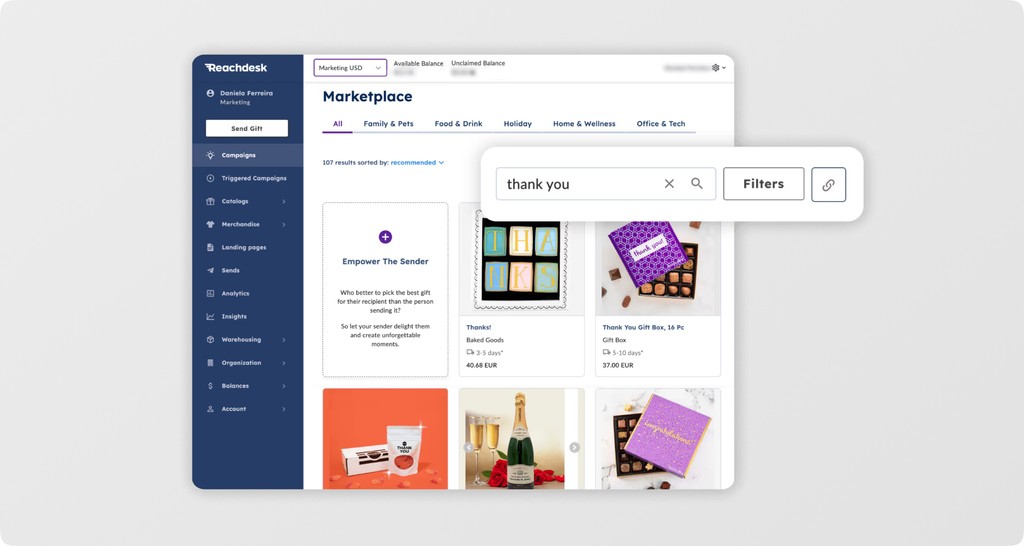
Reachdesk is a global gifting and swag platform that lets GTM teams send personalized gifts, branded merchandise, and event swag to prospects and customers anywhere in the world. It centralizes sourcing, fulfillment, warehousing, shipping, and ROI tracking in one system—so teams can run gifting as a repeatable motion rather than a manual, one-off tactic.
What makes it perfect for demand generation is that it integrates with CRM and MAP tools, you can automate sends based on triggers like form fills, pipeline stage, or account status, and measure the revenue impact of each gift directly in your GTM workflow.
How Reachdesk supports demand generation teams
Modern demand gen needs attention. Reachdesk ties gifting to CRM logic and account intent. This means higher meeting acceptance rates, accelerated middle-of-funnel movement, and a measurable way to use gifting to keep buyers engaged.
Reachdesk key features
- Global gifting network: Send personalized gifts and swag to 180+ countries with localized fulfillment.
- Swag sourcing and warehousing: Source branded merchandise, store it globally, and ship on-demand without managing inventory yourself.
- Automated gifting: Trigger sends based on CRM conditions, MAP workflows, or intent signals.
- Benchmarking dashboard: Compare your gifting performance against platform-wide client averages to understand how your campaigns stack up across key metrics.
Reachdesk pricing
Reachdesk pricing starts at $20,000 per year. You can contact their team for a custom quote.
8. PartnerStack
Best for: GTM teams that want to scale partner-sourced revenue such as affiliates, co-sell, B2B influencers, resellers, and referral networks.
Source
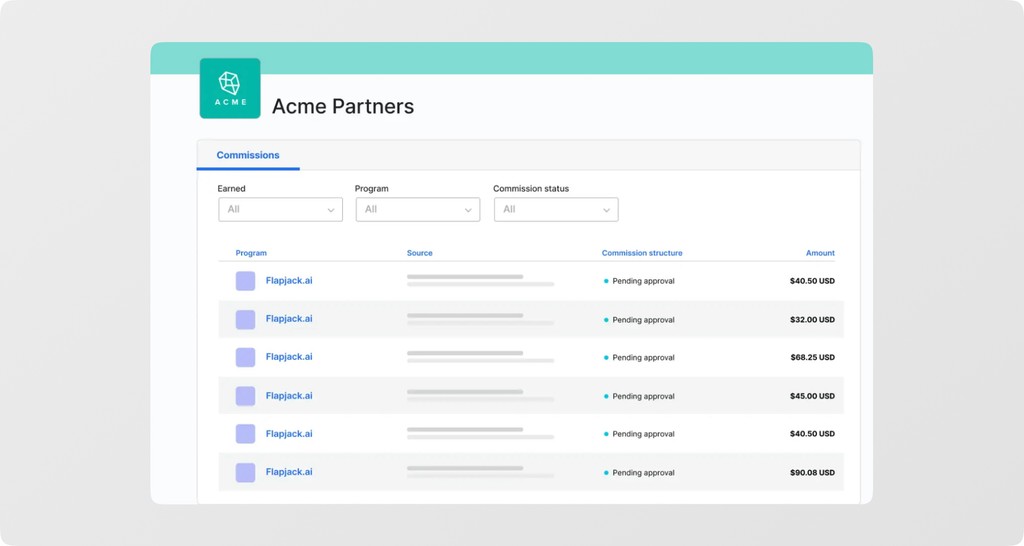
PartnerStack is a partner relationship management platform plus a marketplace. You recruit partners from a 100K+ network or invite your own, automate onboarding and enablement, track every referral or deal, and automate commission calculation and payout.
It also maps partner activity (links, deal registrations, referrals) back to CRM records, applies flexible commission triggers, and issues a single monthly invoice that consolidates partner payments. They even released an AI feature that helps you discover and recruit the best-fit partners faster.
How PartnerStack supports demand generation teams
PartnerStack turns partnerships into a predictable demand channel by removing the operational drag that keeps most partner programs from contributing real pipeline. Instead of unmanaged referrals and messy spreadsheets, partner-sourced leads flow directly into your CRM with full attribution. They enter your existing scoring and routing logic, and trigger the same nurture or sales workflows as inbound. This means clear visibility into which partners influence deals, how much pipeline they generate, and which programs deserve expansion.
PartnerStack key features
- Partner recruitment: Promote your program to 131,202 active partners via the PartnerStack Marketplace.
- Custom application flows: Build branded, customizable partner application forms and manage approvals in one place.
- Partner portal: Give partners a centralized portal for resources, reporting, rewards, and announcements.
- Deal registration: Allow reseller partners to register deals with custom forms and sync updates with your CRM.
PartnerStack pricing
PartnerStack takes the custom pricing route so you’ll have to contact their team for a quote.
9. Hockeystack
Best for: GTM, demand gen, and revenue teams that need unified, clean GTM data and AI agents that turn that data into insights, plans, and actions.
Source
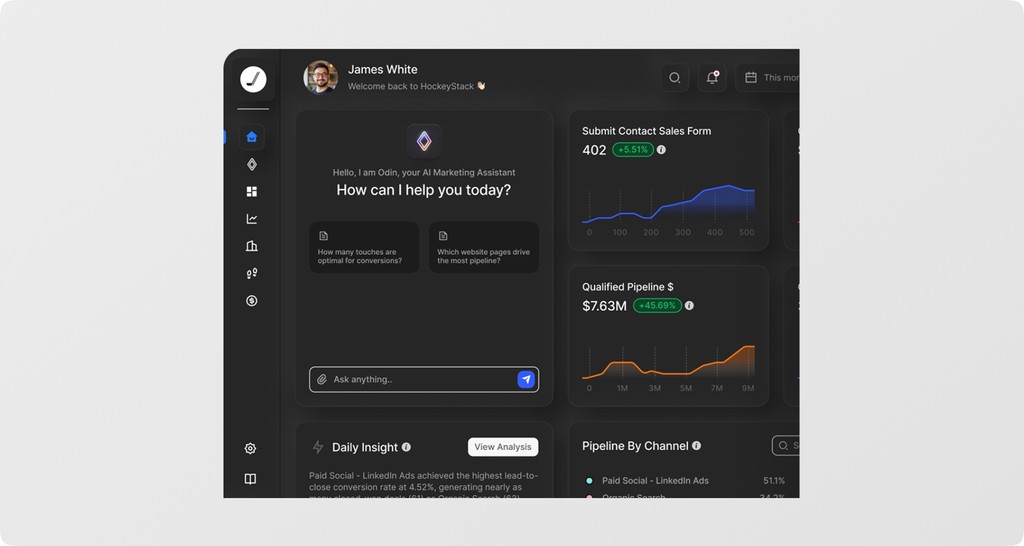
HockeyStack is a GTM intelligence platform built on a data foundation called Atlas, which ingests raw structured and unstructured data across CRM, MAP, ad platforms, website activity, and data warehouses. It deduplicates identities, applies company-specific definitions (like funnel stages), and unifies everything into person, company, action, and metadata objects.
Two AI agents operate on top of Atlas:
- Odin AI Analyst answers questions in plain English, explains performance, visualizes data, and gives next-step recommendations.
- Nova AI analyzes any account using CRM data, calls, emails, and web signals to produce account scoring, stakeholder maps, and meeting prep.
Teams can act on these insights instantly via custom reports, out-of-the-box dashboards, buyer journeys, and automated GTM workflows. The result: clearer attribution, faster adjustments, tighter sales — marketing alignment, and more conversions from the same budget.
How HockeyStack supports demand generation teams
HockeyStack gives demand gen teams an accurate, unified view of the entire buyer journey without manual stitching. It connects marketing, sales, product, and web data into one model, so you can pinpoint which campaigns, channels, and touchpoints actually drive pipeline and revenue.
HockeyStack key features
- Unified data foundation: Ingests raw structured and unstructured data from CRM, MAP, ad platforms, website activity, and warehouses.
- Identity resolution: Merges people, companies, actions, and metadata into clean entities.
- Out-of-the-box dashboards: Funnel performance dashboards ready within 24 hours of connecting data sources.
- Cookieless tracking: Tracks journeys without cookies by default.
HockeyStack pricing
HockeyStack starts at $2,200 per month for the platform. ABM, sales intelligence, and data warehousing solutions cost extra.
10. VWO
Best for: PLG demand gen teams optimizing onboarding, activation, and upgrade paths using fast, high-volume experimentation and precise personalization.
Source
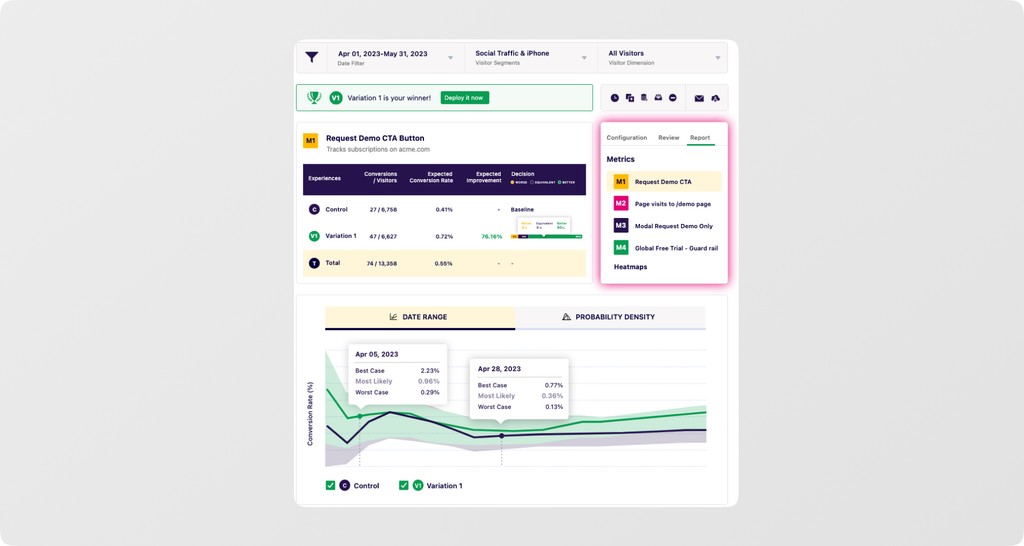
VWO is an end-to-end experimentation and personalization platform that lets teams test anything across web, mobile apps, and backend flows—from copy and layout changes to server-side logic and feature variants. It combines qualitative insights (session recordings, heatmaps, form analytics, surveys) with A/B and multivariate testing, plus a no-code visual editor for rapid iteration without engineering.
You also get unified reporting and Bayesian stats that show whether each variation wins, loses, or performs equivalently, so you can make data-driven optimizations.
How VWO supports demand generation teams
VWO replaces guesswork with behavioral insights that reveal where funnels break, then validates fixes through controlled experiments that teams can ship without engineering support. Demand gen can rapidly optimize campaign pages, accelerate demo requests and trial activations, improve paid media efficiency, and personalize experiences for ABM segments or high-intent visitors.
VWO key features
- Test your apps and websites: Run A/B, multivariate, and server-side testing experiments across websites, mobile apps, and backend environments.
- Qualitative behavior analytics: Set up heatmaps, session recordings, funnels, form analytics, and surveys to identify friction and generate hypotheses.
- VWO Copilot: Generate test ideas, build variations from natural-language prompts, and summarizes user behavior automatically.
- Advanced targeting: Build granular audiences using customer data from any connected source.
VWO pricing
VWO provides a free plan where you can try out all their products. Their paid plans start at around $249 per product, per month, and vary depending on the number of monthly tracked users (MTUs).
Best practices to build your demand generation tech stack
The best stacks create a unified GTM nervous system that turns signals into actions without manual work. Here’s what actually matters when assembling yours:
Start with your data layer
Your stack only works if CRM, MAP, website analytics, ad platforms, and intent signals resolve into a single identity model. Build the data layer first — clean ingestion, identity resolution, funnel definitions, and lifecycle rules — so every downstream tool operates on the same truth. If this layer is wrong, routing breaks, attribution misfires, and scores become meaningless.
Prioritize tools that push insights into workflows
Insights should trigger action automatically, not sit in visualization tools. Select platforms that push recommendations, alerts, scoring updates, or nurture triggers directly into CRM or MAP workflows. The goal is reducing human interpretation and speeding up how quickly data becomes action.
Evaluate tools based on how they shorten GTM feedback loops
Select tools that help you understand why performance changed and immediately act on it. Whether it’s content visibility, account signals, partner influence, or campaign effectiveness, each system should compress the time from insight to decision to execution.
Choose platforms that reduce channel fragmentation
Every new tool creates operational overhead unless it replaces or consolidates work. Favor platforms that handle adjacent motions together like “experimentation and personalization”, or “interactive demos and AI demo agents.” That way, you avoid a sprawl of niche point solutions that each require separate admin and data stitching.
How Layerpath is built for the future of demand generation
Demand generation is shifting from channel-first execution to experience-led growth, where every touchpoint must feel connected, contextual, and fast. Buyers expect journeys that adapt to their intent in real time, and GTM teams need systems that eliminate silos, unify data, and activate insights instantly.
Layerpath solves this with interactive demos built for conversion.
For demand gen teams, this means dynamic, always-on product experiences that clarify value instantly, and qualify visitors through what they interact with — not arbitrary form fields.
Related reading
Frequently asked questions
1. What’s the difference between experience-led demand generation and traditional channel-led demand gen?
Traditional demand gen pushes messages through channels and hopes buyers respond; experience-led demand gen delivers product-driven, personalized interactions that let buyers explore value on their own terms. Instead of interruption, it uses contextual product experiences, intent signals, and adaptive journeys to move prospects forward.
2. How do I know which demand generation tools belong in my tech stack for 2026?
Pick demand generation tools that unify data, surface intent early, automate action (not just insights), and reduce channel fragmentation. Any tool that doesn’t shorten your time from signal to action or can’t integrate cleanly into your GTM workflows doesn’t belong in the 2026 stack.