
Marketers have been among the first to experiment with AI. In fact, the majority of marketers view AI as positive: 64% have favorable feelings about AI's impact on marketing, business, and society, while only 5% have negative feelings.
But that openness also means you’ve sat through many mediocre demos. The AI marketing tools market is crowded with platforms that rebrand basic automation as "AI-powered," chatbots that can't handle real questions, and all-in-one suites that do twenty things poorly instead of one thing well.
This guide focuses on tools that are both exciting and actually functional. We're not covering generic platforms or repackaged features. These are AI-first products — built with real intelligence at their core — that solve specific marketing problems exceptionally well. Each one removes friction from workflows that currently waste hours, whether that's inbound buyer education, qualitative research, competitive monitoring, or lead qualification.
Here are 9 AI marketing tools worth experimenting with in 2026.
How marketing teams use AI at work
AI is far more useful in marketing than drafting blog posts or generating social captions. The practical value shows up in the unglamorous work: collecting signals, cleaning data, watching competitors, turning raw inputs into usable insights, and keeping campaigns moving without manual effort.
Here’s where it actually makes a difference.
Buyer education and engagement
Most visitors come with questions that aren’t answered by static pages — pricing ranges, feature differences, integration fit, security details, or whether your product solves their specific workflow.
AI agents cover this gap in real time — eliminating top-of-the-funnel friction. They let people ask whatever they need and give accurate, product-specific answers without forcing them to click around. Instead of losing interested visitors to confusion or friction, you get a clean record of what they asked, what they cared about, and where they hesitated.
Market and audience understanding
Most teams struggle with getting a clear picture of what customers are thinking right now. AI helps by pulling together signals you normally have to chase across search data, community threads, competitor pages, interviews, and support conversations. Instead of sifting through screenshots and tabs, you get the themes, sentiment shifts, and patterns already grouped and ready to act on.
Operational automation
A lot of marketing work is — unavoidably — just moving information around. You’re pulling numbers, cleaning data, updating sheets, routing leads, packaging weekly reports, or merging inputs from multiple tools.
AI can run these steps in the background so teams aren’t stuck maintaining the plumbing. It’s less about creativity and more about removing the routine work that slows down campaigns.
Top 9 AI tools for marketers looking to experiment in 2026
AI now sits inside every part of the marketing workflow — not just as a standalone content generator. So instead of broad “AI platforms,” this list focuses on targeted products that do one job exceptionally well and remove the operational drag that slows teams down.
But first, a quick overview of what we’ll be covering below:
| Tool Name | Tool Category | Pricing |
|---|---|---|
| Gumloop | AI automation and workflow builder | Free plan available; paid plans start at $37/user/month |
| Quantilope | Consumer and market research | Custom pricing |
| Speak | Qualitative research and AI insights | Free plan available; paid plans start at $15/month |
| Brandwatch | Social listening and consumer intelligence | Custom pricing |
| Browse AI | Web scraping and monitoring | Free plan available; paid plans start at $48/month |
| Merlin | Multi-model AI assistant + Chrome extension | Free plan available; paid plans start at $29/user/month |
| Seventh Sense | Email optimization platform | HubSpot: $960/year (5,000 contacts); Marketo: $5,400/year (50,000 contacts) |
| Crayo | Short-form AI video creation | Starts at $19/month for 50 AI videos |
| FeedHive | Social media management | No free plan; paid plans start at $19 per month |
1. Gumloop
Best for: Marketing teams that want to automate research, content operations, and data-heavy workflows without relying on engineers or multiple point solutions.
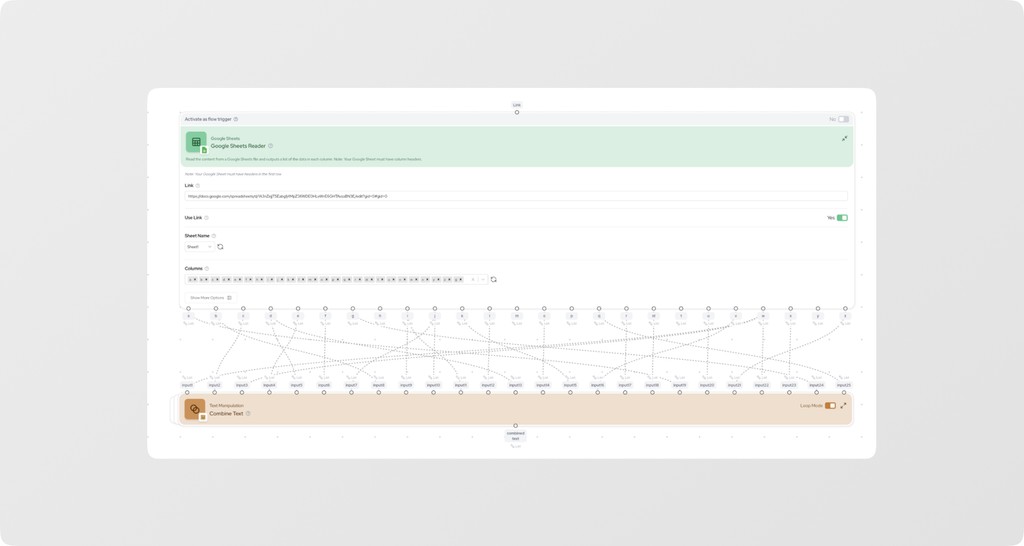
Gumloop is a visual automation platform that connects AI models (GPT-4, Claude, Gemini) to your existing marketing tools through drag-and-drop workflows. Think Zapier, but built for tasks that require AI reasoning — like scraping competitor sites, analyzing social sentiment, or turning a YouTube video into a blog post and three LinkedIn carousels.
What makes Gumloop different is that it includes premium AI model access out of the box. You don't need your own OpenAI or Anthropic API keys. It also runs workflows in parallel, so you can process thousands of leads, posts, or data points at once without waiting in a queue.
However, it takes time getting used to. It's not as plug-and-play as Zapier or Make. You'll need to invest time upfront to understand how nodes connect and how workflows execute. But once you get it, you can automate a lot of marketing processes.
Gumloop key features
- Visual workflow builder: Drag-and-drop interface for creating multi-step automations without code.
- Web and app scraping: Pull data from websites, social platforms, or apps and feed it into your workflows.
- Continuous AI agents: Set up workflows that monitor data sources in real time and take action when conditions are met (e.g., flag negative sentiment, spot competitor mentions).
- 60+ pre-built templates: Get started faster with workflows designed for common marketing tasks like SEO research, content calendars, and lead scoring.
- Gummie AI assistant: An in-platform chatbot that helps you design workflows and can even build them for you based on what you describe.
Visual workflow builder: Drag-and-drop interface for creating multi-step automations without code.
Web and app scraping: Pull data from websites, social platforms, or apps and feed it into your workflows.
Continuous AI agents: Set up workflows that monitor data sources in real time and take action when conditions are met (e.g., flag negative sentiment, spot competitor mentions).
60+ pre-built templates: Get started faster with workflows designed for common marketing tasks like SEO research, content calendars, and lead scoring.
Gummie AI assistant: An in-platform chatbot that helps you design workflows and can even build them for you based on what you describe.
Gumloop pricing
Gumloop provides a free plan that includes 2,000 credits per month. Paid plans start at $37 per user, per month, and include 10,000 credits — though you can purchase more if you require. However, credits only roll over on the Enterprise plan.
2. Quantilope
Best for: Brand, product, and insights teams at mid-to-large companies that need to run frequent consumer research like concept testing or pricing studies.
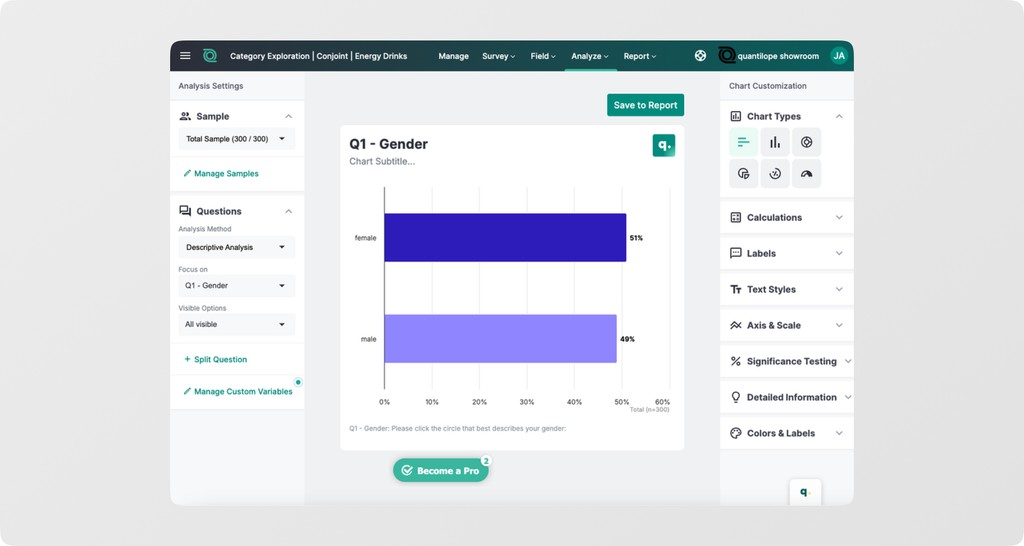
Quantilope is an end-to-end consumer research platform that automates the entire market research process — from survey design to data collection, analysis, and reporting. It's built for running advanced research methodologies (conjoint analysis, MaxDiff, brand tracking, pricing studies) that traditionally required behavioral scientists or expensive agencies.
You build studies by selecting from 15 pre-programmed advanced methods, customizing your questions, and fielding to respondents, and watch as insights populate into dashboards automatically. And Quinn, the AI co-pilot, actually suggests inputs you might not have thought of and writes summaries in your brand's tone.
Quantilope key features
- 15 automated advanced research methods: Pre-programmed methodologies including conjoint analysis, MaxDiff, TURF, Implicit Association Tests, Van Westendorp pricing, and segmentation.
- inColor qualitative video research: Collects video feedback from respondents and automatically analyzes for keywords, emotions, and sentiment.
- Better Brand Health Tracking (BBHT): Supports modern tracking methodology based on Ehrenberg-Bass research principles (Category Entry Points, Mental Availability) rather than traditional funnel metrics.
- Panel-agnostic: Connect to any panel provider or use Quantilope's trusted network for fielding.
15 automated advanced research methods: Pre-programmed methodologies including conjoint analysis, MaxDiff, TURF, Implicit Association Tests, Van Westendorp pricing, and segmentation.
inColor qualitative video research: Collects video feedback from respondents and automatically analyzes for keywords, emotions, and sentiment.
Better Brand Health Tracking (BBHT): Supports modern tracking methodology based on Ehrenberg-Bass research principles (Category Entry Points, Mental Availability) rather than traditional funnel metrics.
Panel-agnostic: Connect to any panel provider or use Quantilope's trusted network for fielding.
Quantilope pricing
Quantilope follows a custom pricing model, so you’ll have to contact their team for a quote.
3. Speak
Best for: Marketing teams that need to extract intent and sentiment from customer interviews or any unstructured qualitative data — without the enterprise price tag of full research platforms.
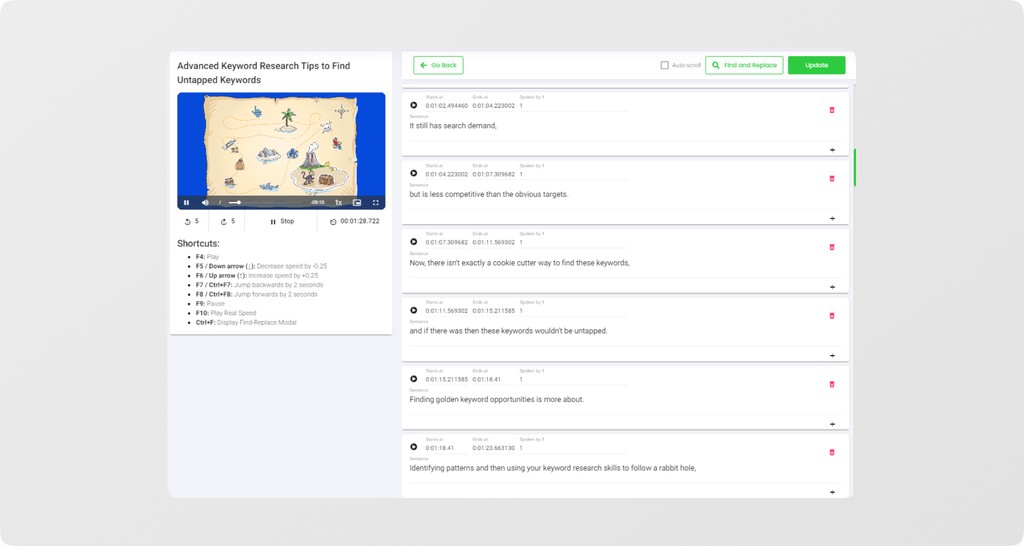
Speak is a market research tool like Quantilope, but it's built specifically for qualitative analysis rather than quantitative surveys. Where Quantilope handles structured research (brand tracking, conjoint studies, pricing tests), Speak handles unstructured data — transcribing interviews, customer calls, focus groups, and videos, then using AI to extract themes, sentiment, and insights from all that messy, open-ended feedback.
You can ask questions of your data using Magic Prompts — like "what are the top product complaints?" — and get instant answers with timestamps and supporting quotes. It also supports web scraping for competitive intelligence, and an AI meeting assistant that auto-joins Zoom calls to record and analyze them.
Speak key features
- Automated transcription in 70+ languages: Convert audio and video into accurate text transcripts with translation support for 150+ languages.
- Magic Prompts: Pre-built AI prompts that let you ask questions of your data and get instant answers with timestamps and supporting quotes.
- AI-powered insights: Automatic sentiment analysis, theme extraction, keyword trends, named entity recognition, and SWOT analysis across all your data.
- Searchable repositories: Create visual, interactive databases of all your qualitative research with data visualizations and easy quote extraction.
- Integration capabilities: Works with Zoom, Google Meet, Microsoft Teams, Vimeo, and Zapier.
Automated transcription in 70+ languages: Convert audio and video into accurate text transcripts with translation support for 150+ languages.
Magic Prompts: Pre-built AI prompts that let you ask questions of your data and get instant answers with timestamps and supporting quotes.
AI-powered insights: Automatic sentiment analysis, theme extraction, keyword trends, named entity recognition, and SWOT analysis across all your data.
Searchable repositories: Create visual, interactive databases of all your qualitative research with data visualizations and easy quote extraction.
Integration capabilities: Works with Zoom, Google Meet, Microsoft Teams, Vimeo, and Zapier.
Speak pricing
Speak offers a free plan with on-demand transcription services that cost $6 per hour. Paid plans start at $15 per month for individuals (25 hours of transcription).
4. Brandwatch
Best for:** Best for:** Enterprise brand marketing teams that need to monitor social conversations, track brand sentiment, and spot trends at a massive scale.
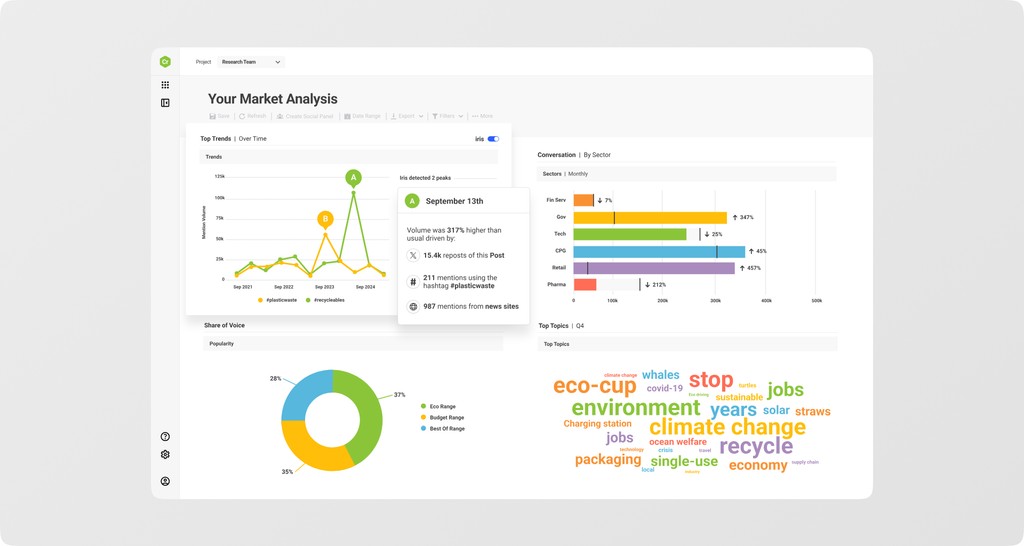
Where Quantilope handles structured surveys and Speak analyzes interviews you conduct, Brandwatch monitors what consumers are already saying organically across the internet. It tracks brand mentions, competitor activity, sentiment shifts, and emerging trends without you having to ask.
The platform uses AI to automatically categorize conversations, extract themes, analyze sentiment (even in images and videos), and predict trends before they peak. You can track how your brand is perceived against competitors, identify PR crises as they emerge, and understand consumer pain points from organic feedback.
Brandwatch key features
- Data archive: Access to billions of historical conversations and consumer opinions across 150+ languages.
- Advanced AI analysis: Automatically categorizes conversations, extracts themes, analyzes sentiment, and predicts trends using proprietary and generative AI.
- Crisis detection and alerts: Real-time monitoring with automated alerts to spot PR issues and negative sentiment spikes before they escalate.
- Competitive benchmarking: Track competitor mentions, sentiment, share of voice, and campaign performance against your own brand.
- Influencer identification: Find and track influencers and brand advocates based on reach, sentiment, and engagement.
Data archive: Access to billions of historical conversations and consumer opinions across 150+ languages.
Advanced AI analysis: Automatically categorizes conversations, extracts themes, analyzes sentiment, and predicts trends using proprietary and generative AI.
Crisis detection and alerts: Real-time monitoring with automated alerts to spot PR issues and negative sentiment spikes before they escalate.
Competitive benchmarking: Track competitor mentions, sentiment, share of voice, and campaign performance against your own brand.
Influencer identification: Find and track influencers and brand advocates based on reach, sentiment, and engagement.
Brandwatch pricing
Brandwatch uses custom pricing, with separate plans for each module: Consumer Intelligence, Social Media Management, and Influencer Marketing. If you’re looking for a ballpark, third-party marketplaces like Vendr put it at $54,000 per year.
5. Browse AI
Best for:** Best for:** Marketing Ops teams that need a reliable data-pipeline layer for competitive intelligence and SEO/content monitoring.
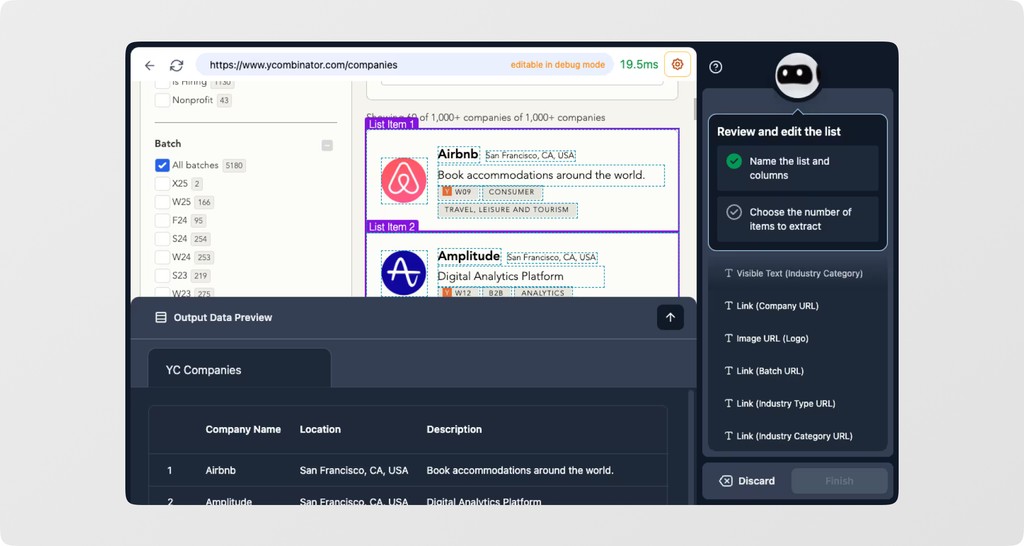
Browse AI is a purpose-built web scraping and monitoring platform. Where a general automation tool (like Gumloop) treats scraping as one node inside broader AI workflows, Browse AI focuses on keeping web data fresh and accessible.
This includes point-and-click training, prebuilt robots for common sites, and always-on monitors that alert you when something changes. You set robots once, they run continuously, and you get structured outputs pushed to Sheets, Airtable, webhooks, or your CRM.
Browse key features
- Prebuilt robots: Ready-made scrapers (LinkedIn, Amazon, Yelp, Zillow, job boards, YC directory, etc.) that shorten time-to-value for common marketing use cases.
- Handles protected pages: Works with JavaScript-heavy sites, login-protected pages, and complex pagination.
- Turn any site into an API: Exposes scraped results as REST endpoints so engineering or BI teams can consume live data programmatically.
- Change detection with rules: Custom alert rules and AI-powered change detection that adapts to layout shifts, reducing false positives.
Prebuilt robots: Ready-made scrapers (LinkedIn, Amazon, Yelp, Zillow, job boards, YC directory, etc.) that shorten time-to-value for common marketing use cases.
Handles protected pages: Works with JavaScript-heavy sites, login-protected pages, and complex pagination.
Turn any site into an API: Exposes scraped results as REST endpoints so engineering or BI teams can consume live data programmatically.
Change detection with rules: Custom alert rules and AI-powered change detection that adapts to layout shifts, reducing false positives.
Browse pricing
Browse AI offers a free plan with 50 credits per month, which lets you scrape 2 websites. Paid plans start at $48/month and include 3 users, 5 websites, and 2,000 credits. However, while the credit-based pricing can be efficient at scale, it is harder to forecast for large, high-frequency jobs.
6. Merlin
Best for:** Best for:** Solo marketers and small teams (5-15 people) who want access to multiple AI models without juggling subscriptions.

Unlike most AI tools that force you to copy-paste between their UI and your actual work, Merlin works directly on whatever webpage you're already using. Press Cmd+M on any site and it appears as an overlay. Reading a competitor's blog? Summarize it instantly. On LinkedIn? Generate a post or comment. Reviewing a YouTube video? Get the transcript and key points without watching the whole thing.
The real advantage is multi-model access. Instead of paying separately for ChatGPT Plus, Claude Pro, and Gemini Pro, you get all three plus Mistral, Llama, and others for $19/month. And when one model struggles with your prompt, switch to another without leaving the interface.
Merlin key features
- 26-in-1 AI assistant: Access GPT-4, Claude 3, Gemini, and other top models in one Chrome extension—no need for multiple subscriptions.
- Projects for brand voice: Upload your brand guidelines, past content, and tone examples to create a custom knowledge base.
- Visual content tools: Access 20+ image generation models plus the Crafts feature to create diagrams, mindmaps, and flowcharts from text prompts.
- AI search integration: Get AI-generated summaries alongside your Google search results to speed up research and competitive analysis.
26-in-1 AI assistant: Access GPT-4, Claude 3, Gemini, and other top models in one Chrome extension—no need for multiple subscriptions.
Projects for brand voice: Upload your brand guidelines, past content, and tone examples to create a custom knowledge base.
Visual content tools: Access 20+ image generation models plus the Crafts feature to create diagrams, mindmaps, and flowcharts from text prompts.
AI search integration: Get AI-generated summaries alongside your Google search results to speed up research and competitive analysis.
Merlin pricing
Merlin offers a free plan with limited access to 70+ AI tools. Paid plans start at $29 per month, per user when billed monthly, and give you unlimited access to the available AI tools. Though there’s a small caveat: the fair use policy means unlimited queries are capped at roughly $100 of API usage per month.
7. Seventh Sense
Best for:** Best for:** Marketing teams with 5,000+ contacts using HubSpot or Marketo who want to increase engagement without sending more emails.
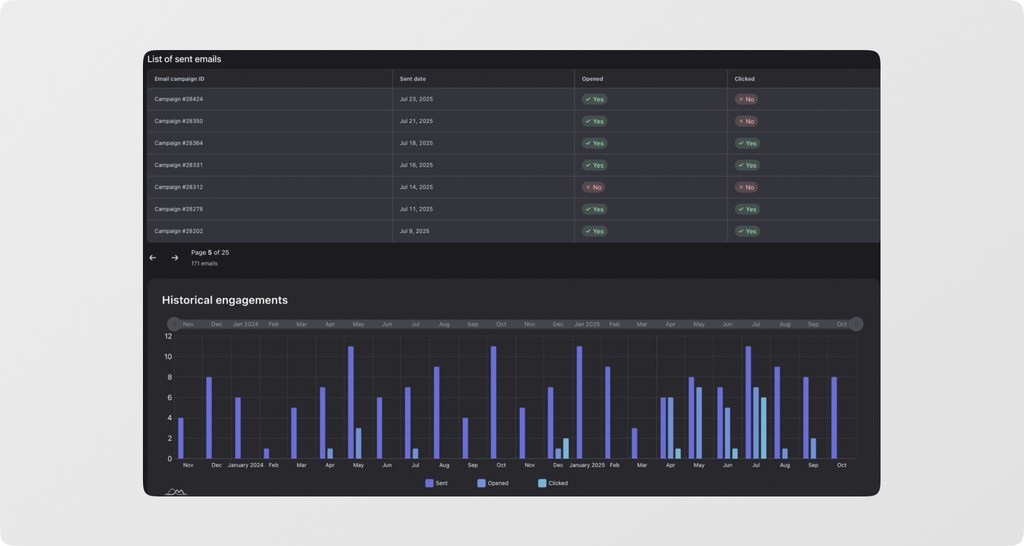
Most email platforms let you send based on recipient time zones, which relies on IP address tracking —something that’s no longer effective with the iOS 15 privacy updates. Seventh Sense takes a different approach. It builds individual engagement profiles by analyzing each contact's historical open and click behavior in your HubSpot or Marketo database, then uses machine learning to predict the specific hour each person is most likely to engage.
The tool also offers three optimization modes:
- 24-hour delivery for time-sensitive emails
- 7-day spread for newsletters
- 7-day schedule that manages both timing and engagement probability
24-hour delivery for time-sensitive emails
7-day spread for newsletters
7-day schedule that manages both timing and engagement probability
However, this dependence on historical, first-party email data also means it’s not ideal for teams just starting out. It’s also only compatible with Marketo and HubSpot.
Seventh Sense key features
- Behavioral send-time optimization: Learns when each contact actually opens and clicks emails, then schedules future sends for those windows.
- Delivery throttling: Spreads email sends across hours or days instead of bulk blasts to improve inbox placement and avoid overwhelming spam filters.
- Frequency optimization: Automatically excludes contacts who haven't engaged recently and predicts who will engage with your next campaign to protect list health.
- A/B testing with optimized timing: Runs split tests while still delivering each variant at personalized times for each contact—both groups get optimal send times.
Behavioral send-time optimization: Learns when each contact actually opens and clicks emails, then schedules future sends for those windows.
Delivery throttling: Spreads email sends across hours or days instead of bulk blasts to improve inbox placement and avoid overwhelming spam filters.
Frequency optimization: Automatically excludes contacts who haven't engaged recently and predicts who will engage with your next campaign to protect list health.
A/B testing with optimized timing: Runs split tests while still delivering each variant at personalized times for each contact—both groups get optimal send times.
Seventh Sense pricing
Seventh Sense is priced based on your marketing automation platform. HubSpot plans start at $960 per year for 5,000 marketing contacts, while Marketo plans start at $5,400 per year for 50,000 contacts.
8. Crayo
Best for:** Best for:** Social media managers and small marketing teams producing 10+ short-form videos per week.
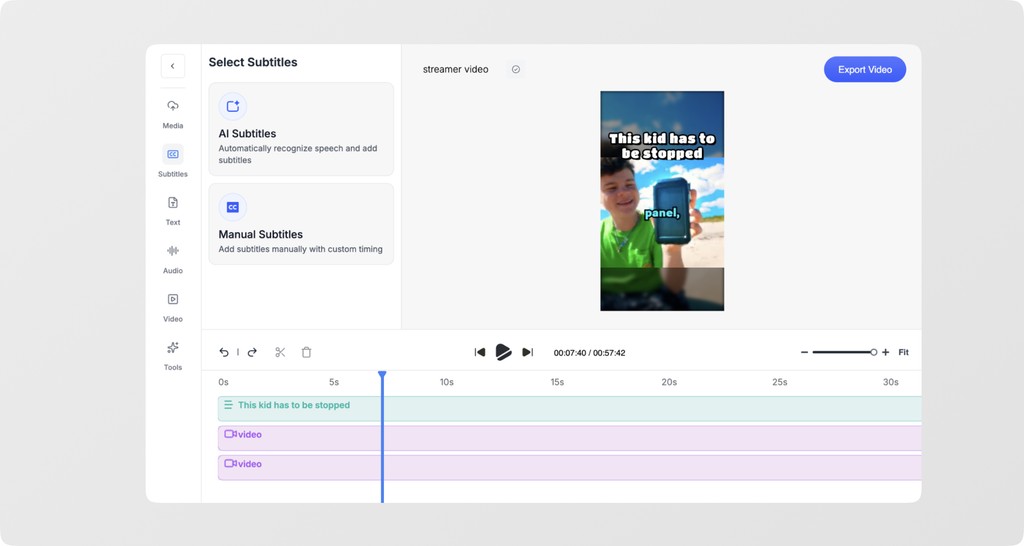
Crayo is an AI-powered short-form video creation platform specifically built for TikTok, Instagram Reels, and YouTube Shorts. Here’s how it works: input a text prompt or topic idea, select a style, choose your AI narrator and background music, and export.
The platform specializes in three video types: story videos (Reddit-style narration over gameplay or stock footage), split-screen videos (reaction or commentary format), and fake text videos (text message conversations). Basically, it’s designed for creators who don't want to be on camera and need high-volume output.
It also integrates Google's VEO-3 video generator technology to convert text prompts into well-structured video scripts with relevant background scores.
Crayo key features
- AI voiceover library: Professional AI narrators categorized by gender, age, and language. Select narrator and platform handles timing and pacing.
- 15+ viral format templates: Pre-built styles based on proven TikTok/YouTube Shorts formats, including Reddit stories, gameplay commentary, and text message conversations. Not generic stock templates.
- Built-in content tools: There’s a YouTube/TikTok video downloader for repurposing content, an AI image generator for custom visuals, and automated subtitle styling with multiple font/animation options.
AI voiceover library: Professional AI narrators categorized by gender, age, and language. Select narrator and platform handles timing and pacing.
15+ viral format templates: Pre-built styles based on proven TikTok/YouTube Shorts formats, including Reddit stories, gameplay commentary, and text message conversations. Not generic stock templates.
Built-in content tools: There’s a YouTube/TikTok video downloader for repurposing content, an AI image generator for custom visuals, and automated subtitle styling with multiple font/animation options.
Crayo pricing
Crayo starts at $19 per month for 50 AI videos. And while they do offer a free trial, you’ll need to subscribe to a plan first to access the product.
9. FeedHive
Best for:** Best for:** Social media managers, small brands, and agencies that need AI-driven content creation and conditional automations.
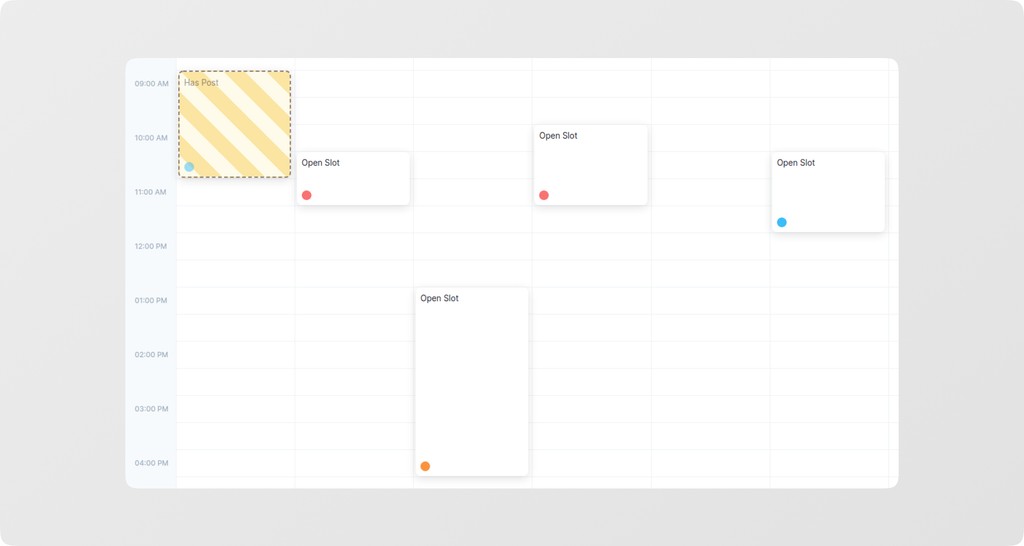
FeedHive is an AI-first social media management platform that brings creation, scheduling, automation, and analytics into one workflow. Instead of treating publishing as a one-way action, FeedHive uses engagement-triggered automation to respond to what happens after a post goes live.
You can set conditions — such as specific like thresholds, comment volume, engagement rates, or time-based triggers — and FeedHive will automatically take follow-up actions. These actions range from posting a clarification or update to recycling evergreen content.
However, it doesn’t monitor brand mentions or sentiment and the AI hashtag generator sometimes produces irrelevant or overly broad hashtags.
FeedHive key features
- AI writing assistant: Generates post ideas, captions, variations, and overcomes creative blocks.
- AI hashtag generator: Suggests relevant tags based on post copy to improve discoverability.
- AI performance predictor: Estimates expected engagement before you publish to avoid low-performing posts.
- Smart scheduling: Recommends optimal post times using historical follower activity and heat maps.
- Content recycling: Automatically re-promotes high-performing evergreen posts without manual tracking.
AI writing assistant: Generates post ideas, captions, variations, and overcomes creative blocks.
AI hashtag generator: Suggests relevant tags based on post copy to improve discoverability.
AI performance predictor: Estimates expected engagement before you publish to avoid low-performing posts.
Smart scheduling: Recommends optimal post times using historical follower activity and heat maps.
Content recycling: Automatically re-promotes high-performing evergreen posts without manual tracking.
FeedHive pricing
FeedHive starts at $19 per month (billed monthly) for four social platforms, 2,000 AI credits, and 30 scheduled posts.
Best practices and tips to build your marketing AI tech stack
The best marketing tech stacks target high-friction workflows first: the repetitive research that eats hours, the content bottlenecks that delay campaigns, or the lead qualification that wastes sales time. Figure out what's broken, then layer in AI that directly fixes it.
Here are some tips for building an actually efficient AI tech stack:
- Map time sinks before buying tools. Track where your team spends the most hours on low-value work — data entry, reporting, content formatting, prospect research. Your first AI tools should target your biggest time drains, not the flashiest features.
- Prioritize tools that integrate with what you already use. An AI tool that doesn't connect to your CRM, CMS, or analytics platform creates more work, not less. Check for native integrations or robust APIs before committing.
- Test with real workflows, not demos. Most AI tools look impressive in a 15-minute demo. Run a paid trial with your actual data and your messiest use cases. If it can't handle your reality, it won't deliver ROI.
- Start with one tool per problem, not one tool for everything. All-in-one AI platforms sound efficient, but often underperform at individual tasks. A specialized tool for social listening will outperform a generic AI suite trying to do 20 things.
- Set clear success metrics upfront. Before deploying any AI tool, define what success looks like: hours saved per week, leads qualified, content pieces produced, conversion rate lift. Without metrics, you're just spending money.
- Don't automate what you haven't optimized. AI accelerates your existing processes — if those processes are broken, you'll just create problems faster. Fix your workflow before you automate it.
Map time sinks before buying tools. Track where your team spends the most hours on low-value work — data entry, reporting, content formatting, prospect research. Your first AI tools should target your biggest time drains, not the flashiest features.
Prioritize tools that integrate with what you already use. An AI tool that doesn't connect to your CRM, CMS, or analytics platform creates more work, not less. Check for native integrations or robust APIs before committing.
Test with real workflows, not demos. Most AI tools look impressive in a 15-minute demo. Run a paid trial with your actual data and your messiest use cases. If it can't handle your reality, it won't deliver ROI.
Start with one tool per problem, not one tool for everything. All-in-one AI platforms sound efficient, but often underperform at individual tasks. A specialized tool for social listening will outperform a generic AI suite trying to do 20 things.
Set clear success metrics upfront. Before deploying any AI tool, define what success looks like: hours saved per week, leads qualified, content pieces produced, conversion rate lift. Without metrics, you're just spending money.
Don't automate what you haven't optimized. AI accelerates your existing processes — if those processes are broken, you'll just create problems faster. Fix your workflow before you automate it.
Related reading
- How AI demo agents improve website conversion rates
- How AI demo agents improve inbound discovery
- AI tools for high-efficiency sales teams
- Why AI-powered demo delivery is the key to pipeline acceleration
Frequently asked questions
1. Are AI marketing tools worth the investment for small teams?
Yes, if you pick tools that solve your biggest time drains. Small teams benefit most from specialized AI that automates repetitive work — like research, data pulls, or lead qualification on websites.
2. How do I measure the ROI of AI tools in my marketing stack?
Track hours saved per week, conversion rate changes, and content output increases before and after implementation. You can also set baseline metrics upfront — like how long reports take or how many leads you qualify — then measure the same after 30-60 days.
3. How do AI marketing tools handle customer data and privacy?
Most enterprise AI tools are SOC 2 compliant and process data through encrypted channels, but you need to verify before buying. Check their data retention policies, whether they use your inputs to train public models, and if they offer data processing agreements.
For regulated industries, prioritize tools with GDPR/CCPA compliance and options to keep data in specific regions.