
A demo is the first real experience a prospect has with your product. It’s where interest should turn into intent. Yet, we rarely look at demos in this light. More often than not, demos are just another tedious task in a long list of sales enablement or onboarding collateral — meaning SaaS companies overinvest in demo creation.
While it’s great that you’ve got a different “demo experience” for each touchpoint in the buyer journey — product videos, gated interactive walkthroughs, demo sandboxes, and more — the overall experience is mostly meh.
Demos are stiff — often off-script — and rarely tailored to what your prospect really needs. By the time sales follow up in 3-5 business days, your prospect has moved to a competitor.
The result: your numbers look great — high views, strong engagement, steady MQLs. But demo-to-close rates? Not good.
And if hooking buyers is one challenge, gauging purchase intent from “demo engagement” is another. Because, as you scale, you attract more noise — people browsing, not ready to buy. Unfortunately, most demos (whether video or interactive) only capture surface-level engagement metrics. So sales reps end up focusing on casual browsers instead of actually interested prospects.
The fix — contrary to what most people assume — isn’t fancier demos or nonstop GTM experiments. You need automated demo delivery that helps you hold attention long enough to signal real intent and move prospects down the pipeline.
Why most SaaS product demos fail to engage — and convert
There are over 200,000 SaaS companies today — only a few are well-established giants. The rest are newer — AI-first — players trying to break through. And if you’re new to the market, you’re also up against a confidence-capability gap: what you can do often far exceeds what buyers believe you can do.
Traditional demos don’t help close the confidence-capability gap. They show off features, assuming that’s enough to earn trust. But buyers often discount what they see from newer players, assuming legacy tools can probably do the same — just not demoed.
So emerging products have to work harder to earn trust, while the familiar ones get a free pass. And this is where most teams start falling behind — not because the product isn’t great, but because the way it's demoed doesn’t match how real buyers evaluate.
You overbuild to prove yourself, but the delivery is flat
Most teams try to close the buyer confidence gap, the only way they know how — by investing more in demo production. You spend $50–$100 per video demo (more if you’re hiring a freelancer or voiceover artist) and build out polished walkthroughs, branching flows, or sandbox environments.
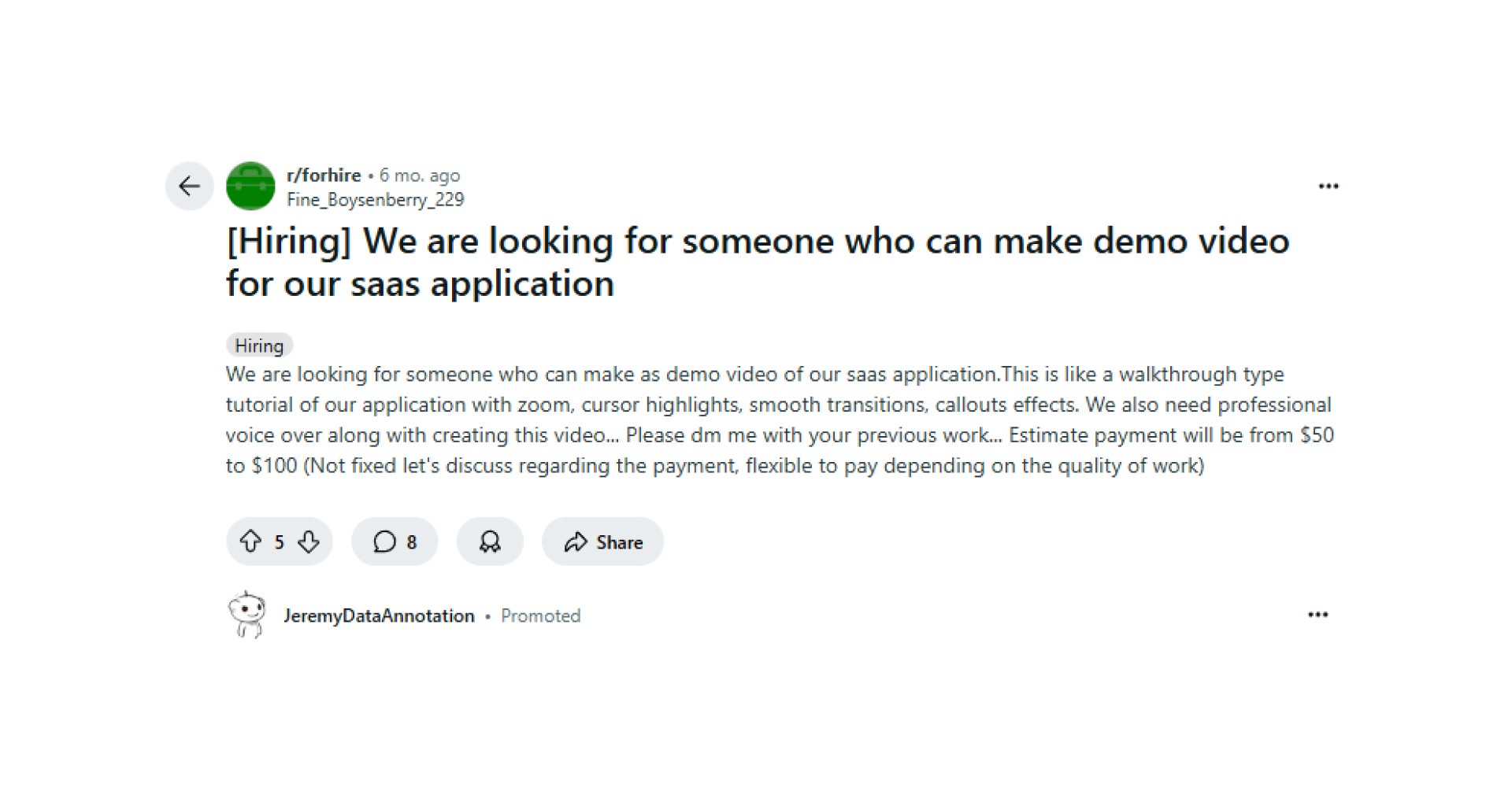
Source: Reddit
It’s a genuine attempt to prove your product’s value and stand out. And on the surface, it all looks impressive. But that effort rarely converts
The product demo feels distant, and buyers don’t really get the context they need to trust what they’re seeing.
Sales cycles slow down because your “demo delivery” is still generic. There’s little personalization, barely any real-time interaction, and no qualification built in.
Your demos show everything — but miss the intent
Buyers are often hit with too many features, too many paths, too many choices — without any clarity on how it relates to their use case. Instead of helping, these demos increase cognitive load: buyers spend mental effort searching for the right demo or scrolling through demos instead of understanding your product’s value.
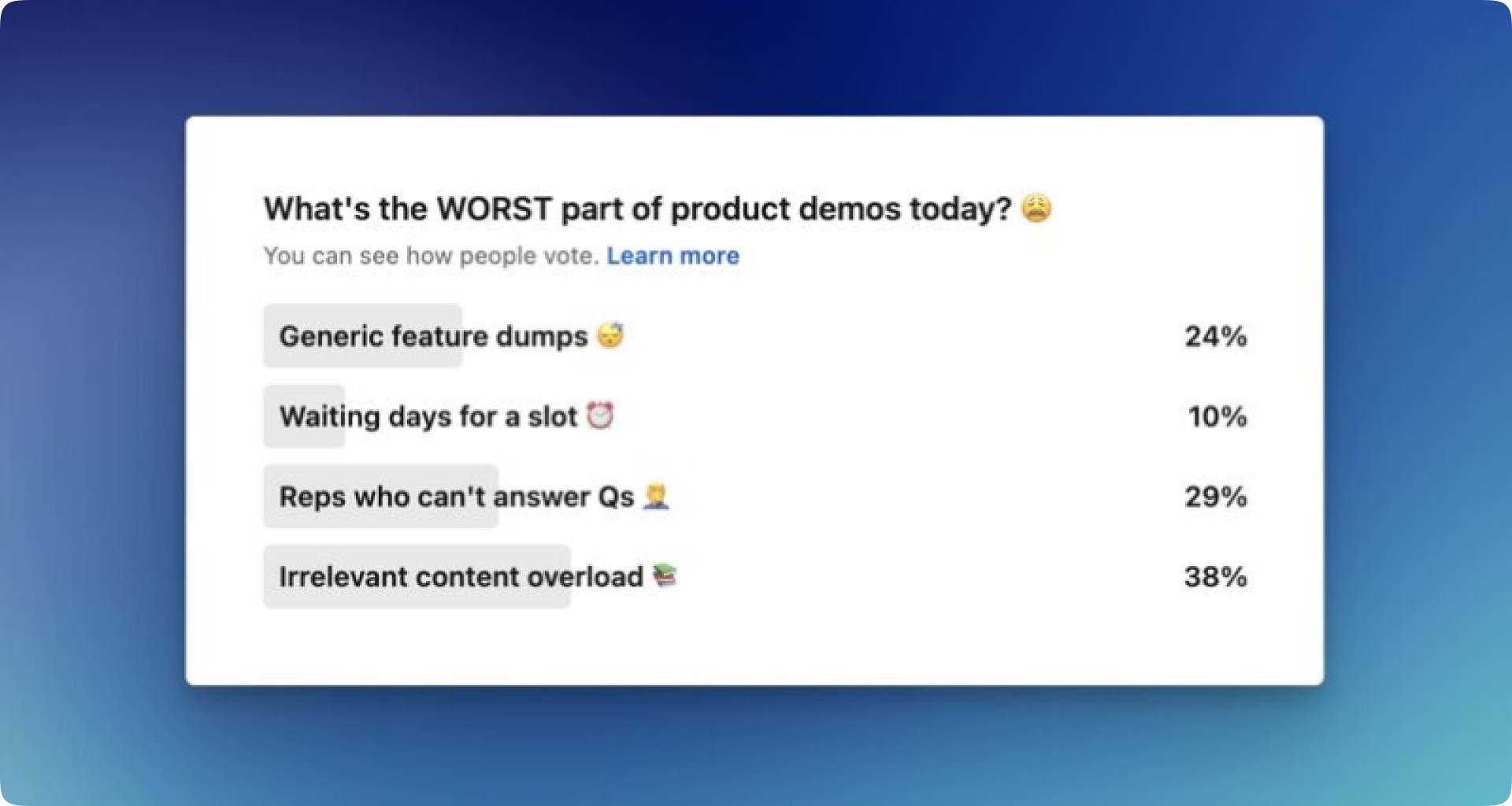
For example, a dashboard walkthrough might look impressive, but if it doesn’t anchor to a buyer’s use case, you lose them before trust even has a chance to form. In fact, when we ran a LinkedIn poll , 38% of respondents mentioned irrelevant content overload as the worst part of product demos. 24% said generic feature dumps
And without that clarity, you don’t just lose attention — you get misleading intent signals. A click-through doesn’t mean interest. A long session doesn’t mean ready to buy. You’re left guessing what actually resonated, and buyers walk away unconvinced.
This silence shows up downstream — in follow-ups that go unanswered and a pipeline full of “engaged” leads who were never actually convinced.
How AI demo agents help you switch from feature broadcasts to real conversations
Referencing MKT-1’s fuel vs. engine framework, we’d say most SaaS teams have no shortage of demos (fuel) but they lack the engine: a channel that delivers these demos at the right moment and the right way so they answer real buyer questions, not just showcase features.
AI demo agents fix this by actively delivering the right demo in real time, adapting to context, and surfacing real intent — not just clicks.
That’s exactly why we’re building Path AI at Layerpath.Most teams are sitting on a mountain of demo content — the fuel — but lack the engine to deliver it with relevance and timing. Path AI can be that engine — a demo agent that delivers the right experience at the right time, and actually listens.
That idea resonated so much that over 500 people have joined the waitlist. ( You can too!)
But first, what is an AI demo agent?
An AI demo agent is a virtual agent that uses information from your demos, website, and internal knowledge bases to guide prospects through your product and answer their questions with context that feels relevant and specific.
Unlike video walkthroughs or even branched interactive demos, AI demo agents don’t just follow predefined paths or canned scripts. Once triggered, they personalize the demo experience in real time — adjusting what they show and how they respond based on a buyer’s profile, past behavior, and responses during the interaction.
Gong fixed SQLs. Now, AI demo agents — like Layerpath’s Path AI — are fixing MQLs.
Gong changed the sales game by proving that more dials don’t mean more deals. Instead of chasing call volume, they analyzed conversations to spot real buying signals — helping sales reps focus on the leads that actually mattered.
AI demo agents bring that same mindset to the top of the funnel. Sure, 50,000 demo views might look great on paper, but static, one-size-fits-all demos rarely move the needle. What works? AI demo agents that make every demo a real-time conversation — one that adapts to a prospect’s interests, questions, and context.
Because meaningful interactions beat vanity metrics every time.
How AI demo agents improve top-of-funnel performance
We’ve seen how AI demo agents work and how they differ from regular demos. Now, let’s explore how that difference directly impacts top-of-funnel performance.
Real-time personalization driven by conversational AI
AI demo agents use conversational AI to make demos responsive — not just interactive. Most interactive demos give the illusion of a two-way conversation. They look engaging, but still follow a fixed path. AI demo agents change that by actually listening, adapting in real time, and responding based on what the prospect says or does.
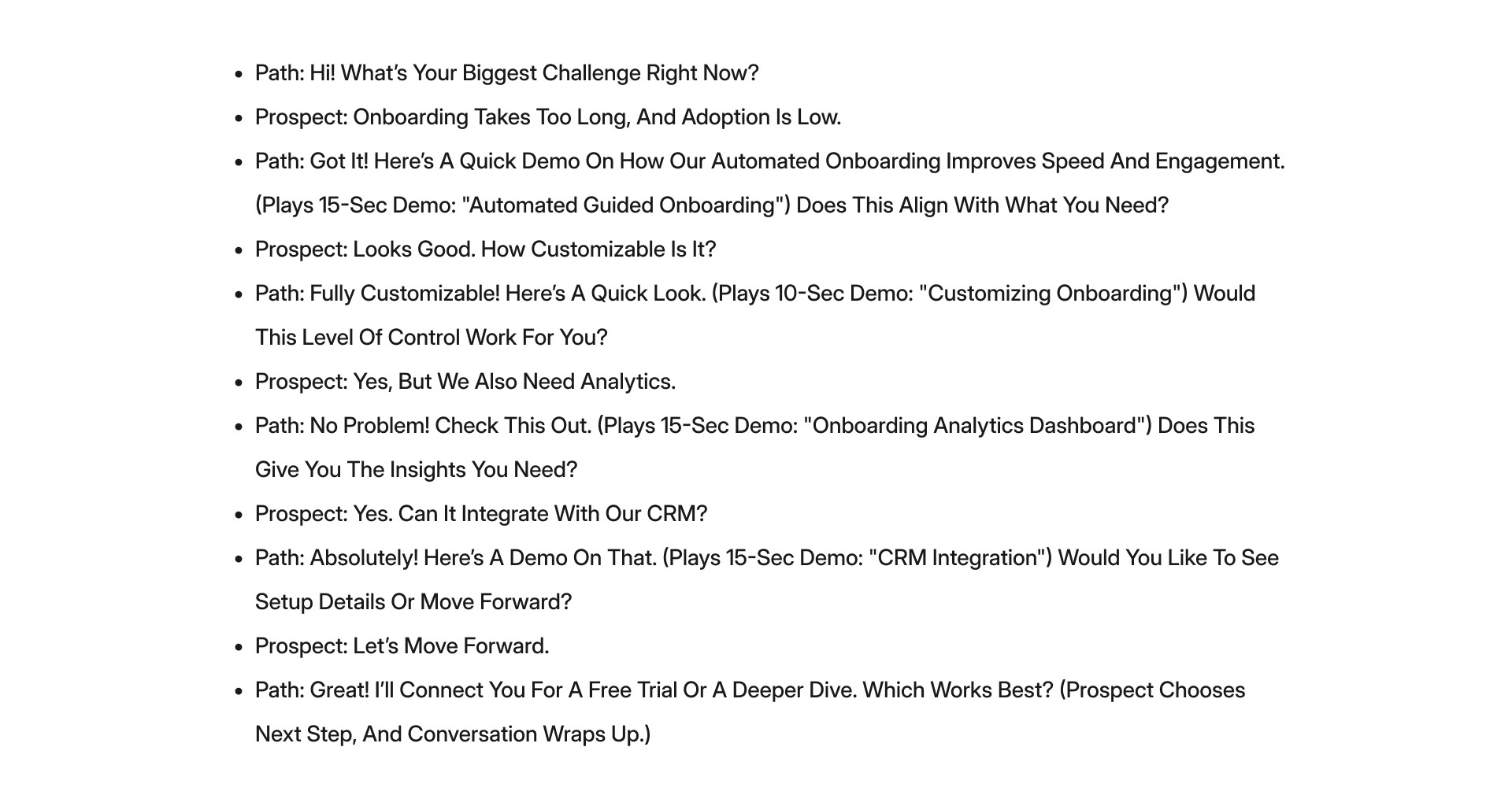
A snippet from Layerpath’s AI demo agent, Path AI’s conversation with a customer
This matters because now prospects can self-qualify. They ask real questions, get real answers, and quickly figure out if your product can solve their problem. If it’s not a fit, they drop off early.
But if they stick around, it’s because they’re genuinely curious. They're exploring with intent, not just clicking around. That means by the time they reach sales, they’ve already signaled serious interest.
Put simply, AI demo agents not just speed but also clean up your funnel — ensuring your pipeline is full of qualified, high-intent leads, not just high-traffic noise.
Lead qualification backed by real engagement signals
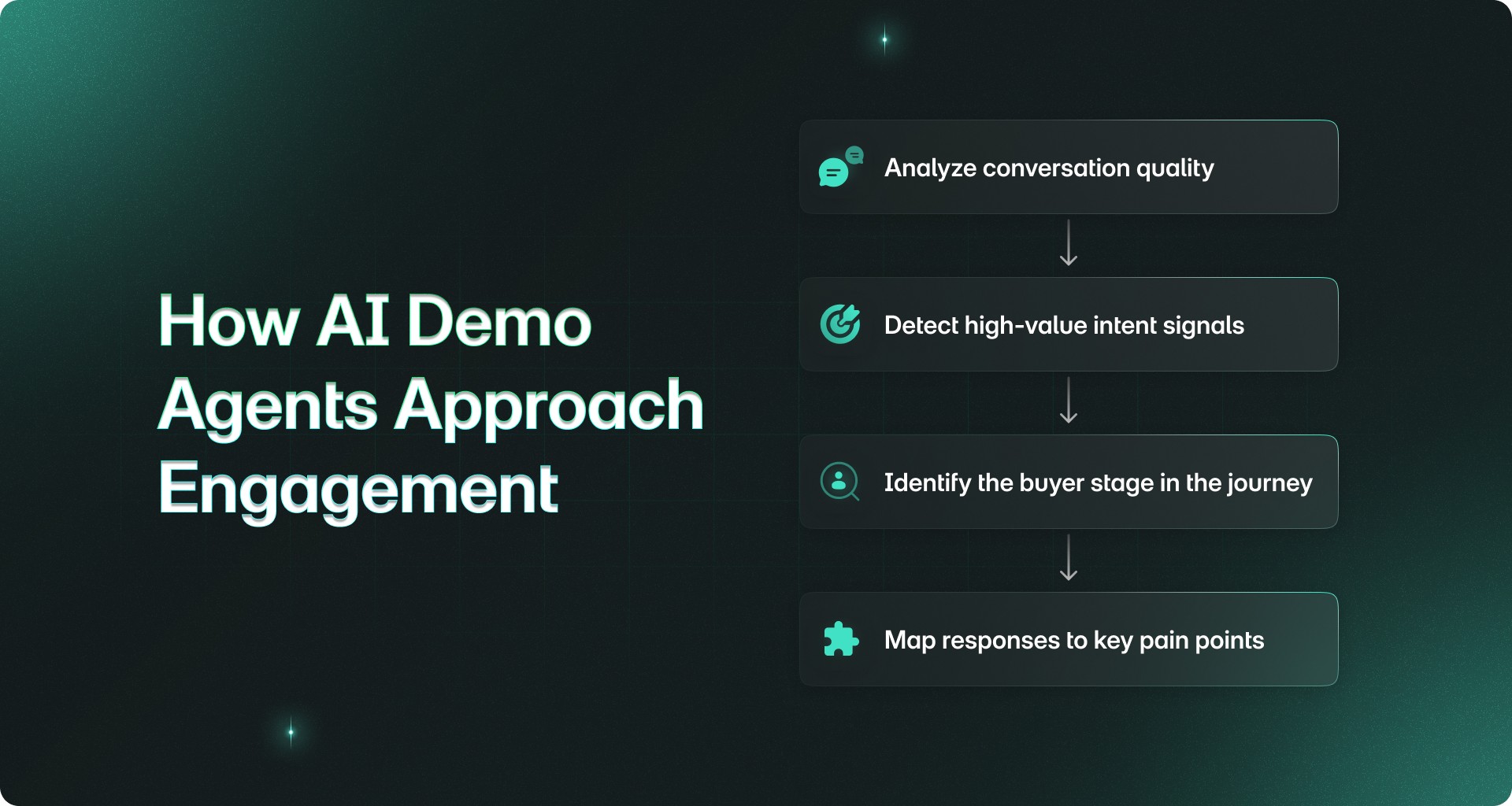
Another benefit to using AI demo agents is how they go beyond the irrelevance of vanity metrics and surface real engagement insights. They analyze every interaction in context, helping you figure out what buyers are truly interested in.
Let’s say you're running a live demo, and a client is more interested in your integration capabilities than the feature overview — you’d likely pick up on this and adjust. While simple interactive demos can’t surface those signals, AI demo agents can.
They pick up on these signals automatically and personalize the experience without manual input, turning passive interest into usable data. This brings context-aware qualification to the top of the funnel. Your team knows not just who’s engaging, but why — and what to do next
AI demo agents identify layered buyer preferences and flag those insights to your sales team — so they can follow up with a pitch that actually resonates.
Qualification depth
The AI demo agent tracks how many key questions a prospect answers during the demo — and how much they engage with content tied to common pain points. This gives your team a real view of how serious a prospect is. The deeper the engagement, the higher the likelihood they’ll convert.
Intent signal strength
Instead of counting clicks, AI demo agents track behaviors that actually predict buying like asking about pricing or implementation timelines. These are strong signals that someone is evaluating fit, not just browsing.
Pipeline velocity
AI demo agents don’t just help move prospects down the funnel — they also give you visibility into how fast they’re moving. Instead of treating the demo as a disconnected touchpoint, the AI tracks key pipeline acceleration metrics, such as demo-to-first-sales-call(for traditional sales teams) and demo-to-sign-up (for product-led growth teams).
These indicators give both sales and marketing teams clear visibility into what’s actually driving pipeline movement — and where it’s getting stuck.
- For marketing teams, it highlights which demo experiences are converting, which messages resonate with high-intent buyers, and which segments are dropping off early
- For sales teams, it shows which prospects are already educated, which objections have been handled in-demo, and where follow-ups should focus
How to link demo performance to revenue outcomes
Now for the most interesting part: how do you bring product demos — and AI demo agents — into your revenue conversations? First, you need to shift how you think about demos — not as pre-sales or marketing content, but as a core part of your GTM motion.
You’ve already got the data. AI demo agents capture exactly how prospects engage, what they care about, and how ready they are to buy. This gives RevOps a clear way to track demo performance and connect it to real revenue outcomes.
Here are some metrics you can track — starting with revenue impact:
- Demo-to-close rate shows how well your demo experience turns interest into revenue. Higher rates mean your demos are doing the heavy lifting.
- Average deal size by demo type tells you if leads qualified by AI demo agents tend to convert into larger, higher-value deals.
- Sales cycle length measures how much faster deals move when leads are already pre-qualified — less time in discovery, more time closing.
Another way to connect AI demo agents to revenue is by looking at operational efficiency:
- Sales capacity reclaimed— how much time your team saves by not chasing low-intent leads
- Discovery call conversion— how often early calls lead to next steps, because AI demo agents qualify prospects correctly
- Follow-up response rate— how prospects respond when sales outreach aligns with their behavior and interests during the demo
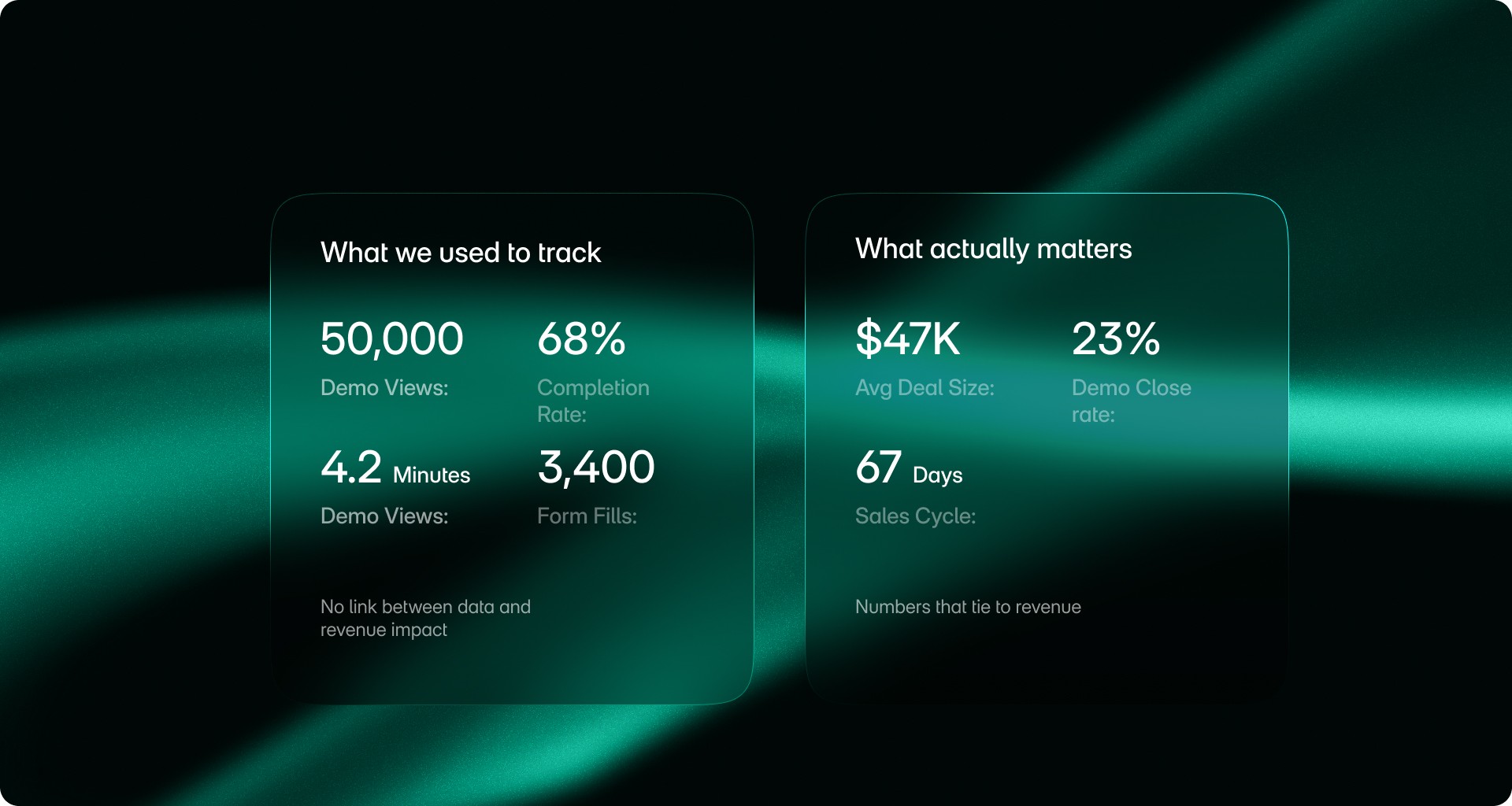
Together, these metrics help you shift demos from something you hope works… to something you know drives revenue.
Let AI demo agents lead top-of-funnel conversations
AI demo delivery doesn’t just make your demos smarter — it makes your entire GTM engine more efficient. You reduce the cost per demo, reclaim sales hours by filtering out low-intent leads, and expand demo coverage without sacrificing quality. But that’s just the start.
And as agentic AI continues to evolve, demo agents will do more than just deliver personalized experiences. You’ll start to see clear patterns: which industries and roles are most likely to convert, which product features consistently accelerate deal velocity, and what specific behaviors signal true buying intent.
This is actionable intelligence that helps every team, from marketing to sales to RevOps, make sharper, faster decisions.
Path AI is built for exactly this.It’s the onlyAI demo agentdesigned to both engage prospects and extract the kind of high-signal intelligence your GTM teams can act on. While most companies are still optimizing demo creation, you can get ahead by automating demo delivery — and turning every interaction into a revenue driver.
Interested in experiencing AI demo delivery in action? Sign up for free , and see firsthand how AI-powered demos can drive real revenue impact. And if you’d like to geek out about the potential of AI and AI-driven demos, you can schedule a 30-minute call with Vinay, our founder.
Frequently asked questions
Why pick a demo automation platform that supports revenue optimization?
A revenue-focused demo automation platform ties demo engagement to pipeline metrics such as lead quality, deal velocity, and rep efficiency. This gives marketing and sales visibility into which audiences convert best and where to focus time and budget for maximum ROI.
How does AI improve the demo-to-revenue pipeline?
AI personalizes demos in real time, qualifies visitors by behavior, passes rich context to sales, and tracks conversion signals. This, in turn, reduces handoff friction and turns more top-of-funnel interest into closed revenue.
What's the ROI timeframe for AI demo delivery?
Most companies see positive ROI within 60–90 days. In the first month, you'll notice time savings and better lead prioritization. By month 3, expect higher demo-to-opportunity rates and shorter sales cycles. By month 6, ROI compounds through increased revenue, improved pipeline quality, and reduced acquisition costs.