
Beyond the frustrating 'experience' factor, this scheduling complexity directly impacts your bottom line — and it's not just the cost of sales reps wrestling with admin work.
GTM teams spend a lot to get people interested, but then watch about 90% of their leads drop off at the “Schedule a Demo” stage — around 35% of them because of scheduling delays.
This isn't just a problem for traditional sales and RevOps teams; even PLG companies with strong self-serve models struggle to convert leads from demo attendees to paying customers. The reason: too much friction, too many chances for failure, and a frustrating experience on both sides.
In this article, we explore why the traditional demo experience is broken and how AI demo agents can be a good alternative — helping you automate the demo experience without letting it become a robotic narration of your feature catalog.
Why traditional live demos fail today’s buyers
For account executives, the frustration often starts with the logistical headache that is scheduling a demo. Coordinating time zones, internal availability, and vacations is challenging enough, but unexpected factors like leave can further complicate things.
In fact, when a sales rep had to cover for a colleague, the poor demo experience led them to spiral and even question their professional competence.
Let’s look at everything that’s broken with the traditional demo experience.
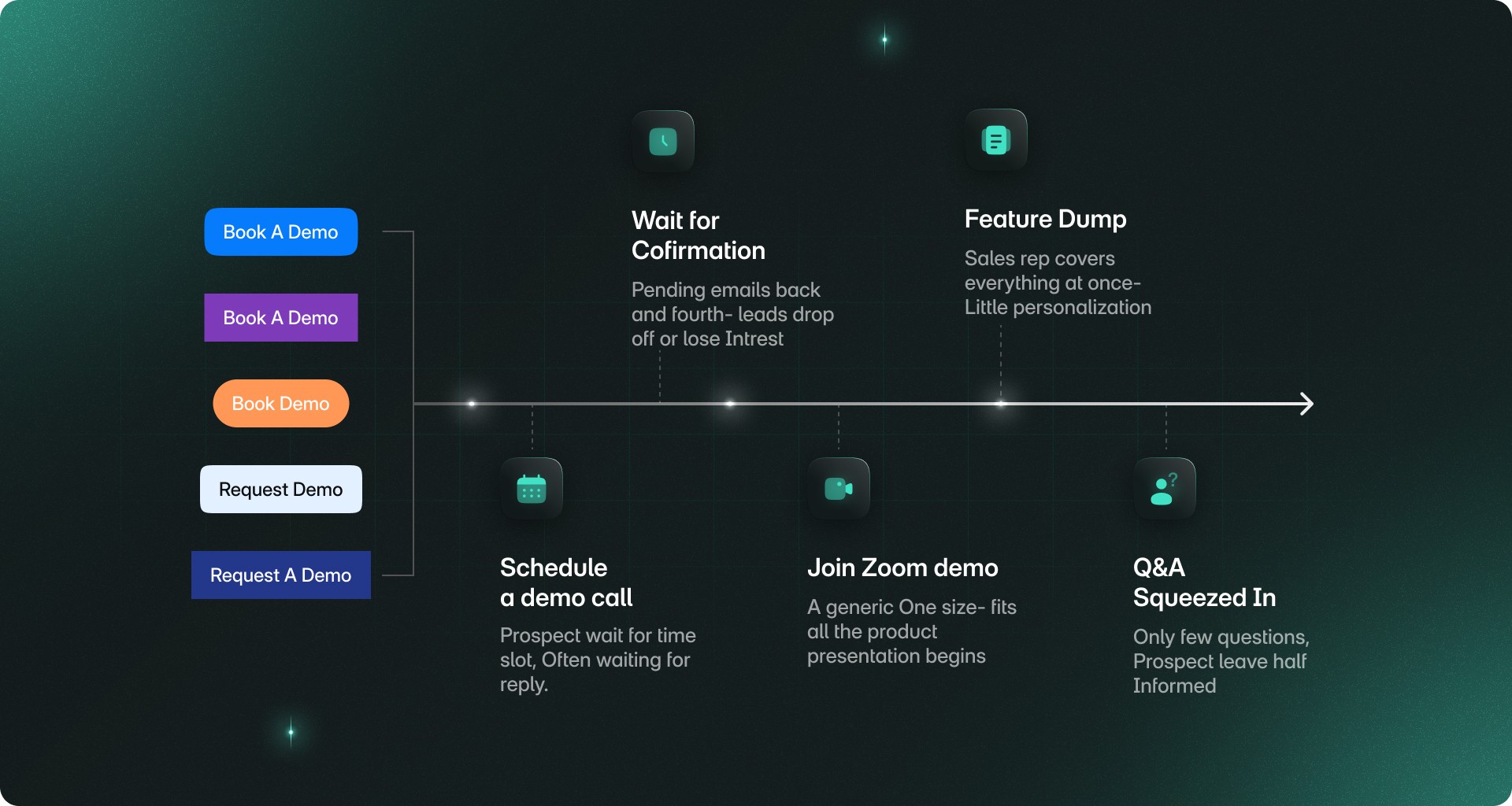
The hoops you jump through in a typical traditional demo experience
One-size-fits-all demos that don’t fit anyone
First, there’s the static, rinse-and-repeat nature of demos, where account executives stick to a well-worn script — repeating the same presentation over and over, with only a few minutes at the end for questions.
This doesn’t resonate with prospects, and there’s barely any time to dive into the specific problems the prospect is trying to solve. This means you might need to schedule another call — and put up with more back-and-forths to finalize another time block that suits everyone.
Like one Redditor puts it: If your demo is more than 20% “show” and less than 80% “discuss,” you’re losing them.
And if talking too much is one problem, talking too little is another — with some prospects feeling like they’ve been bled dry after discovery and demo calls.
A seller-first experience that frustrates buyers
Despite the broader Go-To-Market (GTM) shift towards a buyer-centric approach, the demo experience often remains stubbornly seller-centric. Modern B2B buyers expect seamless, B2C-like experiences — preferring self-serve and immediate interactions with the product over waiting a week to "talk to sales” and end up getting an irrelevant demo.
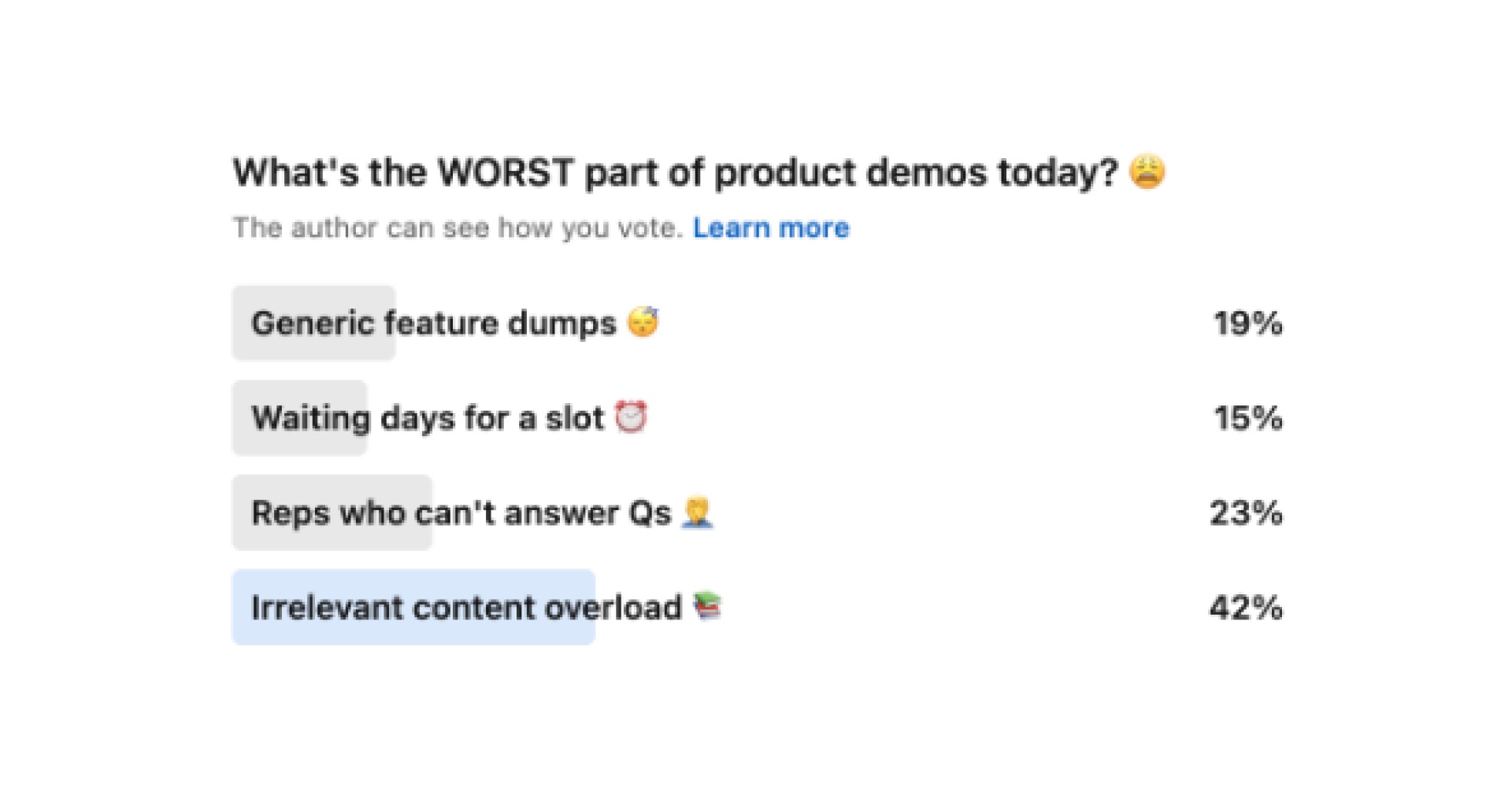
The results of a poll we ran on Layerpath’s CEO, Vinay’s, LinkedIn account
No wonder prospects feel sales demos are all about giving AEs the advantage to interrogate prospects and push for a sell (most often when they barely know the product). A Reddit thread highlights an interesting conflict: Comments from buyers mention they prefer seeing a demo before a call, while sellers say demo calls have led to more sales.
One thing for sure — buyers want more control over their experience, moving away from seller-driven, one-way demos. And to stay relevant, the GTM teams must create a demo process that adapts to this new buyer-first reality.
Scaling hiccups where demos turn into bottlenecks
For high-growth SaaS companies, the traditional live demo model can quickly become unsustainable. A SaaS company even implemented a no-demo policy because their product was simple enough for self-serve, yet they got more demo requests than their sales team could handle.
Instead of converting leads, the demo process became their friction point — forcing them to turn away potential customers simply because they lacked the bandwidth.
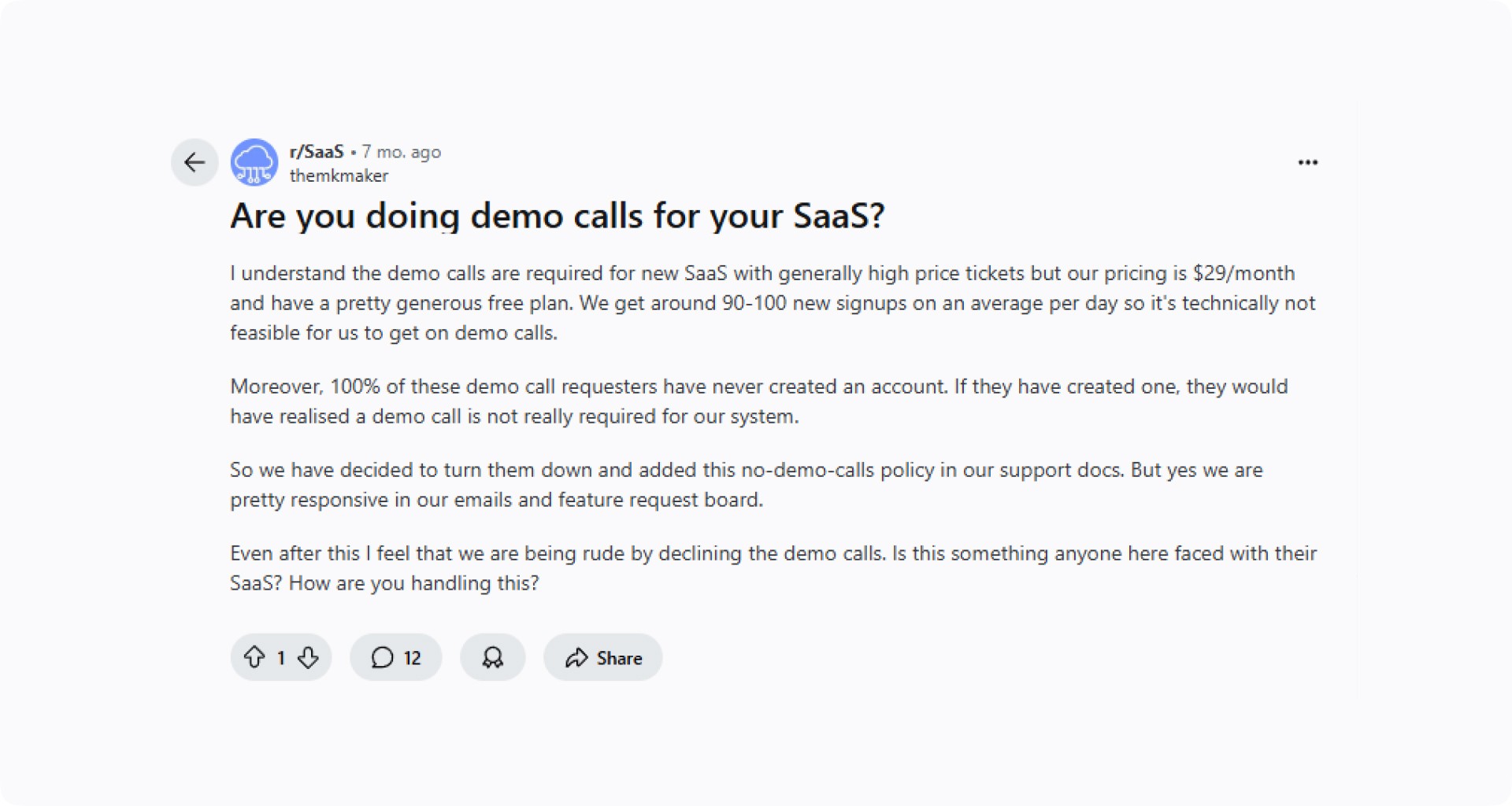
Source: Reddit
Another challenge that scaling B2B teams experience is the disconnect between marketing and sales. Different KPIs drive misalignment, and sales teams are often overwhelmed by the sheer volume of marketing content they don’t even know exists.
Meanwhile, sales teams get real-time feedback and competitive insights from customers, but this rarely makes its way back to product marketers — creating a gap in strategy and execution.
Put simply, traditional demos slow down the sales cycle, increase drop-offs, and limit scalability — all of which will hurt revenue growth.
How AI demo agents are changing demo delivery
AI demo agents aren’t just making demos more convenient — they’re making them more profitable. Because when buyers say they want “better demos,” they mean “on-demand conversations” that help them make faster, more confident purchase decisions.
But first, what is an AI demo agent?
An AI demo agent is the ‘demo’ version of a chatbot. By drawing on your demo assets and brand information it creates personalized demos in real-time, adapting to the individual prospect's requirements. This ensures hyper-relevant demos that feel like two-way conversations instead of a one-way video demo or interactive walkthrough.
AI demo agents use a combination of:
- Natural Language Processing (NLP) to understand and respond to buyer questions
- Interactive demos to guide prospects through relevant features, use cases, and next steps
Let’s explore how AI demo agents are redefining the traditional (and mostly seller-centric) demo experience to better align with buyer preferences — and ultimately boost your conversion rates.
Instant, on-demand demos that reduce drop-offs
Every day a prospect waits for a live demo is a day they could lose interest — or even worse — book with a competitor. The longer the wait, the higher the drop-off. AI demo agents eliminate this friction by providing instant, self-serve access, keeping high-intent buyers engaged, and moving through the funnel.
In fact, Gartner found that companies using interactive, self-serve demos see 10x higher conversion rates from demo to SQL. And with AI demo agents adding the ‘conversation factor’ to interactive click-through demos, you’re sure to see an even higher increase in conversion rates.
No wonder, almost 57% of traditional SLG companies plan to implement PLG strategies for TOFU growth.
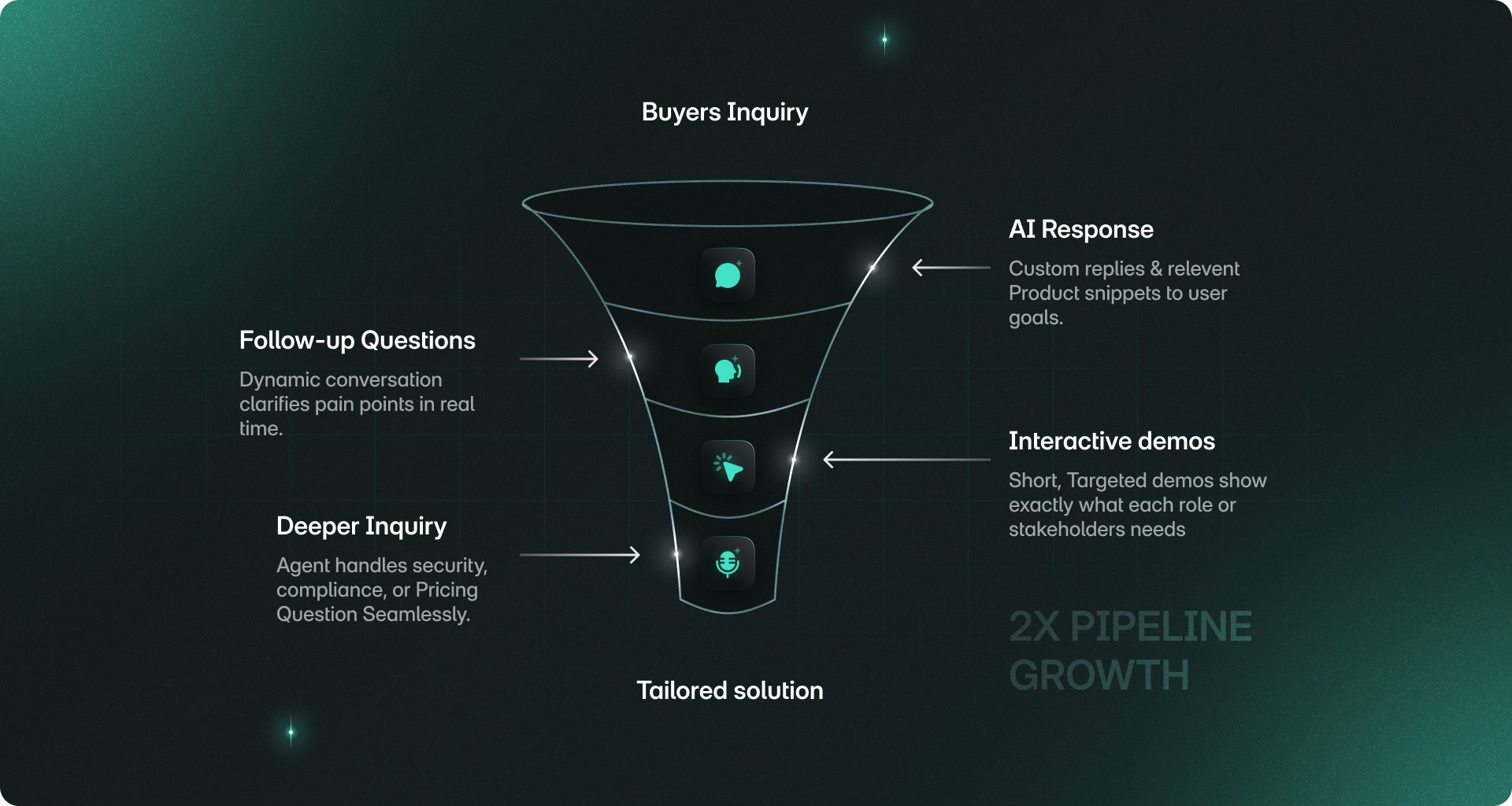
How AI demo agents redefine the traditional demo funnel — and help with pipeline growth
Dynamic demos optimized for conversion
Traditional demos are one-size-fits-all, which means they often fit no one. AI-driven demos, on the other hand, ensure each prospect is heard. They can adapt in real-time based on:
- Buyer persona (e.g., executives see ROI-focused content, technical users get deep dives)
- Industry and use case, tailoring the product’s value proposition
- User behavior, emphasizing the features they interact with most
The result? AI demos with:
- Contextual understanding , which is a deep understanding of each stakeholder's specific priorities
- Adaptive dialogue that is more than one-way scripts and yes/no conversations
- Genuine intelligence that goes beyond conditional, rule-based workflows
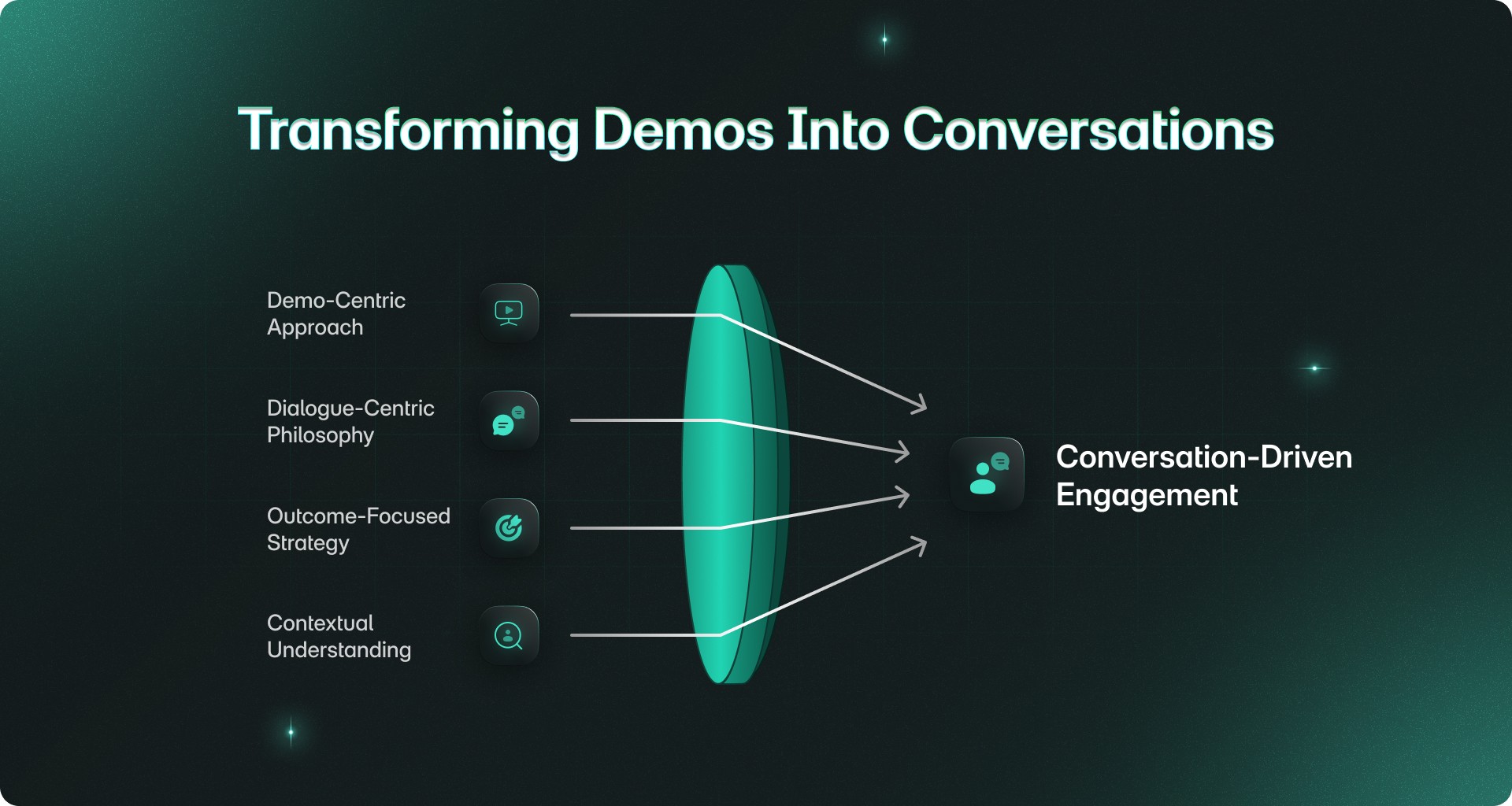
How AI demo agents transform demos into conversations
But the best part — AI demo agents personalize not only the content presented but also how it's delivered. Depending on the prospect’s interaction style, you can give them a two-way conversation or a more direct presentation. As your demo is both relevant and relatable, there are higher chances of leads moving down the funnel.
Moreover, AI demo agents can help GTM teams analyze buyer engagement in real-time. The more a prospect interacts with your demo — exploring key features, asking questions, or spending time on certain sections — the stronger their intent.
It is built-in lead scoring — helping you identify high-value prospects who are ready for a deeper conversation.
100x demos, same headcount
Demos aren’t just a once-and-done event. In most B2B deals, multiple demos happen throughout the sales cycle. But with sales reps already struggling — only 33% are hitting their quotas in the first half of the year — relying solely on live demos isn’t the most sustainable approach.
AI demo agents handle top-of-funnel demo requests, so reps spend their time on qualified, high-intent buyers. Plus, you can scale your self-serve experiences, helping PLG and hybrid sales motions convert more users into paying customers.
Even better, this approach can optimize your resources (and revenue) —
- Reduced costs: Cost per demo goes down from $40-50 for traditional human demos to a mere $2 with AI.
- Increased sales productivity: Reclaim valuable sales hours spent on routine demos to focus on high-value activities.
- Faster progression from MQLs to SQLs: While everyone experiences the demo, only high-intent buyers get passed to sales — less time is wasted on low-priority or uninterested leads.
AI-driven feedback loops for conversion optimization
Unlike video demos (that rarely ever improve) or live demos (where sales teams have to relay prospect insights to marketers), AI demo agents adapt to feedback in real-time. They capture and analyze prospect interactions — questions asked, features explored, conversation style, and drop-off points — allowing them to refine the demo experience even as it happens.
This capability manifests in two ways:
- By prioritizing high-interest features and adjusting the conversation style based on previous interactions
- By acting on engagement data in the moment — such as shifting to a deeper focus on technical capabilities when a buyer asks technical questions.
This data also benefits your overall GTM, revenue, and even engineering goals:
- Sales teams get real-time insights on which prospects are most engaged, making outreach more targeted.
- Marketing teams can refine messaging based on what resonates most with buyers.
- Product teams gain visibility into feature requests and objections, helping shape future roadmap decisions.
Buyer-first demos where prospects are actually heard
In a traditional sales demo, buyers often feel like they’re being talked at rather than engaged with. AI demo agents shift this dynamic, removing the pressure and giving buyers the freedom to explore your product without the high-stakes, sales-heavy nudges. Especially as you can train your AI model to be helpful and not aggressive.
With AI demo agents, you:
- Let buyers interact on their own terms— no pushy sales tactics
- Provide real answers upfront— no hiding key details behind a sales call
- Make demos feel like experiences, not pitches— helping buyers understand real value faster
Buyers don’t just evaluate products — they evaluate the buying experience. A positive, no-pressure interaction can turn inbound interest into real pipeline, without the unnecessary friction.
The future of B2B sales: AI-driven, self-serve, low-friction
For too long, SaaS sales has been stuck in a seller-centric mode, banking on brand equity to force buyers into rigid processes that don't fit their needs. This has resulted in major buyer frustration — especially when it comes to things like booking a demo just to explore a product, or get pricing information.
(It’s even become a bit of a joke with several memes and even a song by Marc Thomas lamenting gated pricing.)
This has — albeit slowly — led to both seller enablement and buyer enablement converging with buyer needs being the north star metric — focusing on real value over templated product pitches.
Instead of just tracking vanity metrics — like the number of demo videos watched or live demos scheduled — GTM teams are asking a far more important question: How much revenue do demos really generate?
These days, AI-driven demo automation has become a part of the broader revenue optimization tech stack — whether that’s PLG companies using them to turn demos into a self-serve growth engine or SLG companies using them to pre-qualify leads and close deals faster.
And that’s what we’re building at Layerpath. For the past year, we’ve helped teams create interactive demos that convert — at scale. Now, we’re launching an AI-powered demo delivery platform that sits well with the rest of your revenue optimization tech stack. It’ll allow you to have almost human conversations with prospects, not just create fancier interaction elements.
And we’ve got some of the biggest SaaS brands — including the likes of ClickUp and Contentstack — hyped about this, with many signing up to be design partners.
With Layerpath’s AI demo agent (available for early access), you can:
- Be available 24/7— eliminating scheduling bottlenecks and keeping prospects engaged when their interest is highest.
- Hyper-personalize demos at scale — adapting in real-time to buyer personas, industries, and engagement patterns.
- Engage in two-way conversations — ensuring a dynamic, interactive experience instead of a monologue-ish pitch.
Interested in experiencing the future of demos? Sign up for early access , and see firsthand how AI-powered demos can drive real revenue impact. And if you’d like to geek out about the potential of agentic AI and AI-driven demos, you can schedule a 30-minute call with Vinay, our founder.
Frequently asked questions
What is the difference between interactive demo software and AI demo agents?
Interactive demo software allows you to create clickable walkthroughs to show prospects how your product works. AI demo agents go further, enabling real-time conversations using a combination of “relevant” interactive demo snippets and hyper-personalized interactions
What to consider when evaluating AI demo solutions?
Some factors to consider when evaluating AI demo agents are:
- Personalization: Can it tailor demos based on user roles, industry, or behavior?
- Interactivity: Does it engage in real-time, two-way conversations or just present static content?
- Lead qualification: Can it track engagement signals and prioritize high-intent leads?
- Integrations: Does it connect with your CRM, sales, and marketing tools?
- Scalability: Can it handle high volumes of demo requests without added cost?
- Real-time optimization: Does it learn from interactions to improve over time?
Can AI demo agents replace human sales representatives?
Not really. They handle top-of-funnel demos, lead qualification, and repetitive product walkthroughs, freeing sales reps to focus on high-intent buyers, complex deals, and relationship-building. The best approach is always AI and humans.